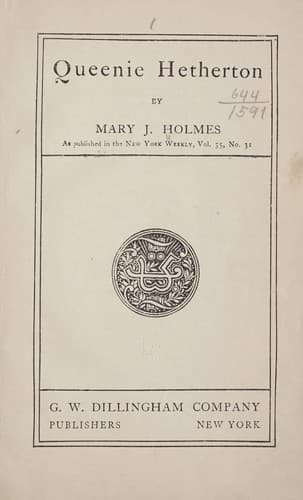
American fiction -- 19th century; Dime novels; Man-woman relationships -- Fiction; Upper class -- Fiction
Phil thought her perfectly charming as she walked restlessly up and down
the platform, waiting for the first sound which should herald the
approaching train. It came at last—a low whistle in the distance,
growing gradually louder and shriller, until the train shot under the
bridge, and the great engine puffed and groaned a moment before the
station, and then went on its way, leaving two distinct groups of people
to be stared at by the lookers-on. One, the Rossiters and a middle-aged
man, dressed in the extreme of fashion, with eye glasses on his nose and
a little slender cane in his hand, which he twisted nervously, while,
with the other members of his party, he looked curiously at the second
group farther down the platform—the three French ladies, who spoke their
native tongue so volubly, and were so demonstrative and expressive in
their gestures and tones. Mrs. La Rue was in black, with a strange
expression on her face and in her eyes, as she watched the two young
girls.
The moment Margery alighted, Reinette had precipitated herself into her
arms, exclaiming:
“You dear old Margie! you have come at last;” while kiss after kiss was
showered upon the girl, whose golden hair gleamed brightly in the
sunlight, and whose blue eyes were full of tears as she returned the
greeting.
Suddenly remembering Mrs. La Rue, Queenie turned toward her, and,
offering her hand very cordially, utterly ignored the fact that she had
ever seen her before by saying:
“I think you are Mrs. La Rue, and I am happy to meet you, because you
bring me Margie.”
“Thanks. You are very kind,” Mrs. La Rue replied, with a tone which a
stranger might have thought cold and constrained but for the face, which
had something eager and almost hungry in its expression, as the great
black eyes were riveted upon Queenie whose hand the woman held in a
tight clasp until it was wrenched away, as the girl turned next to the
Rossiters.
“Wait, Margie,” she said, in passing. “Our carriage is here, and I am
going to take you to your new home.”
Then hurrying on she went up to her aunt, and cousins, and the major,
who had been watching her curiously, and mentally commenting upon her.
“Quite too much sentiment and gush for me. I like more manner; more
dignity,” he thought, while Mrs. Rossiter saw only her sister’s child,
and Ethel and Grace felt a little disappointed with regard to the
beauty, of which they had heard so much.
Public-domain text, read in full here on John Shaqi.
Reviews
Reviews
No reviews yet
Be the first to share your thoughts on this work.
Elsewhere in the archive
Join the Discussion
Join the discussion
Sign in to leave a comment or review.
Sign InorCreate an account