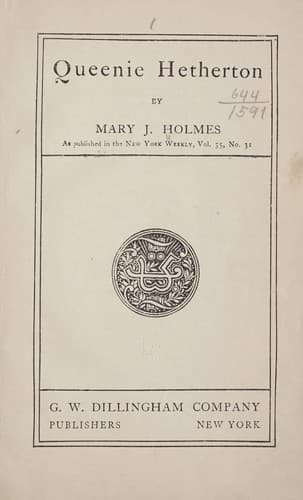
American fiction -- 19th century; Dime novels; Man-woman relationships -- Fiction; Upper class -- Fiction
But when she came toward them, her head erect, her cheeks flushed, and
eyes shining like diamonds and seeming almost to speak as they danced,
and laughed, and sparkled, they changed their minds, and when the great
tears came with a rush, as she threw herself into Mrs. Rossiter’s arms,
exclaiming, “Oh auntie, I am going to love you so much, and you must
love me with all my faults, for I have neither father nor mother, now,”
they espoused her cause at once, and never for a moment wavered in their
allegiance to her. Giving each of them a hand, and kissing them warmly,
she said, laughingly: “You are all alike, aren’t you? tall and fair, and
blue-eyed—so different from me, who am nothing but a little black
midget.”
“That’s the Ferguson of us,” Phil said, with a meaning smile, which
brought a flush to his sister’s cheeks, and made Queenie laugh, as she
retorted:
“I wish I were a Ferguson then, if that would make me white.”
“A deuced pretty girl, after all,” the Major thought, as she beamed on
him her brightest smile when Phil introduced her, and then the parties
separated. And returning to Margery, Queenie led her in triumph to the
carriage, while Mrs. La Rue followed after them.
Her black gauze vail was drawn closely over her face, but both girls
caught a sound like a suppressed sigh, and turning to her, Margery said:
“I believe mother is homesick, and pining for France she seems so low
spirited.”
“Oh, I hope not. America is a great deal better than France, and
Merrivale is best of all,” Queenie said, glancing at Mrs. La Rue, and
noting for the first time how pale and tired she looked, noticing, too,
that she was all in black, though not exactly in mourning.
“She has lost some friend, perhaps,” she thought, and then chatted on
with Margery, unmindful of the woman who leaned wearily back among the
soft cushions of the luxurious carriage.
Of what was she thinking?—the tired, sad woman, as the carriage wound up
the hill, across the common, past the church where Margaret Ferguson
used to say her prayers, and past the yellowish-brown house which
Queenie pointed out as her Aunt Lydia’s, and where, on the door-step
Anna sat fanning herself, rejoicing that she was now a grocer’s
daughter. It would be hard to fathom her thoughts, which were straying
far back over the broad gulf which lay between the present and the days
of her girlhood. And yet nothing escaped her, from Anna Ferguson on the
door-step to the handsome house and grounds at the Knoll, which Queenie
said was her Aunt Rossiter’s house; but when at last the cottage was
reached, and she alighted from the carriage, she was so weak and faint
that Margery led her into the house, and even Queenie was alarmed at the
death-like pallor of her face, and stood by her while Margery hunted
through her bags for some restorative.
“You are very tired, aren’t you?” Queenie said, kindly, to her, at the
same time laying her hand gently upon her head, for her bonnet had been
removed.
Public-domain text, read in full here on John Shaqi.
Reviews
Reviews
No reviews yet
Be the first to share your thoughts on this work.
Elsewhere in the archive
Join the Discussion
Join the discussion
Sign in to leave a comment or review.
Sign InorCreate an account