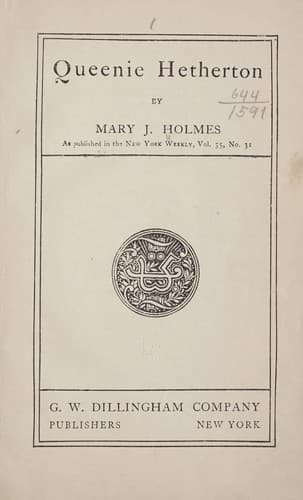
American fiction -- 19th century; Dime novels; Man-woman relationships -- Fiction; Upper class -- Fiction
At the touch of those cool, slender fingers and the sound of the pitying
voice Mrs. La Rue gave way entirely, and grasping both Queenie’s hands,
covered them with tears and kisses; as she said:
“Forgive me, Queenie, and let me call you once by that pet name; let me
thank you for all you have done for us—for Margery and me. God bless
you, Queenie! God bless you!”
“Mother, mother, you frighten Miss Hetherton!” Margery said, coming
quickly forward, and guessing from the expression of Queenie’s face,
that so much demonstration was distasteful to her. “You are tired and
nervous; let me take you up stairs,” she continued as she led the
unresisting woman to her room, where she made her lie down upon the
couch, and then went back to Queenie, who was standing in the door-way
and beating her little foot impatiently, as she thought:
“I wonder what makes that woman act so? The first time I ever saw her
she stared at me as if she would eat me up; and just now there was
positively something frightful in her eyes as they looked up at me; I do
not believe I like her.”
Just here Margery appeared, apologizing for her mother, who, she said
was wholly overcome with all Queenie’s kindness to them.
“Yes, I know. I do it for _you_,” Queenie said, a little petulantly, for
she did not care at all if Margery knew of her aversion to her mother.
It was time now for her to go if she would see her cousins, and
promising Margery to look in upon her in the morning and bring her a
pile of dresses which needed repairing, she entered her carriage, and
was driven to the Knoll, where the family were just sitting down to
supper.
Taking a seat with them, Queenie talked and laughed, and sparkled, and
shone, until the room seemed full of her, and the bewildered major could
have sworn there were twenty pairs of eyes flashing upon him instead of
one, while Ethel and Grace held their breath and watched her as the
expression of her bright face changed with every new gesture of her
hands and turn of her head.
“She is so bright and beautiful, and different from anything we ever
saw,” they thought, while Mrs. Rossiter, though no less fascinated than
her daughters, was conscious of a feeling of disappointment because she
could discover no resemblance to her sister in her sister’s child. She
was unmistakably a Hetherton, though with another look in her dark face
and wonderful eyes which puzzled Mrs. Rossiter as she sat watching her
with constantly increasing interest, and listening to her gay bad-Phil
and the major, the latter of whom seemed half afraid of her, and was
evidently ill at ease when her eyes lighted upon him.
Supper being over Reinette arose to go, saying to her aunt and cousins:
“I shall expect you to dine with me to-morrow at six o’clock. It is to
be a family party, but Major Rossiter is included in the invitation. I
am going now to ask grandma and Aunt Lydia. Will you go with me, Phil?”
Public-domain text, read in full here on John Shaqi.
Reviews
Reviews
No reviews yet
Be the first to share your thoughts on this work.
Elsewhere in the archive
Join the Discussion
Join the discussion
Sign in to leave a comment or review.
Sign InorCreate an account