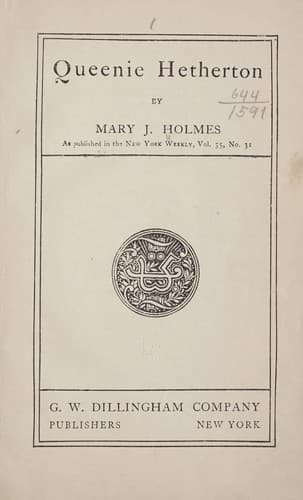
American fiction -- 19th century; Dime novels; Man-woman relationships -- Fiction; Upper class -- Fiction
The former opposed the plan with all her strength, for life without Phil
would be nothing to the mother who loved him so much. Mr. Rossiter, on
the contrary, approved it. It was no way for a young man to hang on to
his mother’s apron strings all his days, he said; Phil ought to do
something for himself. This was only a repetition of the old story of
idleness and ease, and confirmed Phil in his purpose. He would make
something of himself—would show that he was capable of higher occupation
than devising trimming for dresses and running a sewing-machine. He was
very sore on the subject of the sewing-machine, and very reticent all
through the dinner, and when it was over excused himself to his sisters,
saying he had letters to write and some few matters which must be
attended to. It was very sudden to them all—his going away—but, as he
said, he was his own master and must act for himself, and when his
mother tried to persuade him to give it up, he answered:
“No, I have staid with you too long. You are the best and dearest mother
in the world, but you have done wrong not to send me away before this,
and make me stay away, too. I should have been more of a man among men.
I see it now, and must take the first chance offered me. A year is not
very long, and I shall write to you every week.”
So Mrs. Rossiter gave it up, and busied herself with various
preparations for his comfort, and said she should go to New York to see
him off, and tried to seem cheerful and happy, and tried, with his
sisters, to fathom the cloud which overshadowed his face, and made him
so unlike himself. What had happened to him, and was Reinette in any way
connected with it? They thought so, and when in the morning he said he
was going to bid his grandmother and Anna good-by, and they asked if he
were not going to see Reinette, too, and he answered: “I saw her
yesterday, but give her this letter when I am gone,” they were sure of
it, and for the first time since they had known her, they felt a little
vexed with the girl, who even then was watching from her window for the
rider coming over the river, across the causeway, and up the long hill
as he would not come again, for when, later in the day, the express
train for New York stopped at West Merrivale, it carried him along
toward the new life which was to have an aim and occupation.
CHAPTER XXVII.
HOW QUEENIE BORE THE NEWS.
Public-domain text, read in full here on John Shaqi.
Reviews
Reviews
No reviews yet
Be the first to share your thoughts on this work.
Elsewhere in the archive
Join the Discussion
Join the discussion
Sign in to leave a comment or review.
Sign InorCreate an account