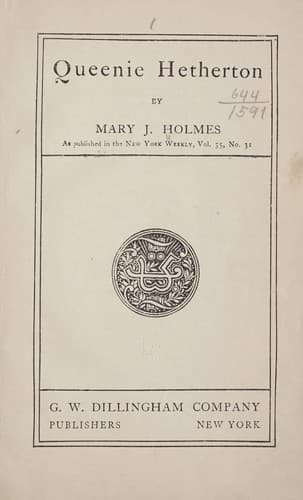
American fiction -- 19th century; Dime novels; Man-woman relationships -- Fiction; Upper class -- Fiction
She saw the long train as it came across the plains from East
Merrivale—saw it shoot under the bridge, past the station, and glide
swiftly on by the river-side until it was lost to view in the deep cut
by the old gold-mine, and remembered that afterward she heard the
whistle as the train stopped at West Merrivale a few minutes and then
went speeding on to the West But she never dreamed that it carried with
it a young man whose face was pale as ashes as he sat with folded arms,
and hat pulled over his eyes, seeing nothing of what was passing around
him, and thinking only of her, listening even then for the sound of his
horse’s feet coming up the hill. For Queenie felt sure he would come
back to her, and that in some way they would make it up, and resume
their old, delightful relations with each other. And she watched for him
all day long, and was beginning to get restless and impatient, when,
about sunset, the Rossiter carriage came slowly up the hill and into the
yard.
In a trice Queenie was at the door, feeling certain that the recreant
Phil had driven over with his sisters, as he sometimes did. But only
Ethel and Grace were there, and it struck Queenie that there was
something a little strange in their manner, while Grace had evidently
been crying.
“I am so glad you have come!” she said, as she led the way into the
house. “I have been so lonely to-day, with not a person to see me except
the major and Anna, who were here a few moments this morning, and who
are so absorbed in each other as to be of no account to any one else. I
do believe he is in earnest, and means to marry her; and then won’t we
have to bow to my Lady Rossiter! Where’s Phil, and why has not he been
here to-day?”
“Phil has gone; you surely knew that, or, at least, that he was going;
he was here yesterday,” Ethel said; and in her voice there was a
hardness, as if her cousin were trifling with her thus to ask for her
brother.
But she knew better when she saw how white Queenie grew, as she repeated
after her:
“Gone, and I knew of his going! You are mistaken; I know nothing. Where
has he gone?”
“To India!” Ethel said.
And then Reinette grasped the chair near which she was standing with
both hands, and leaning heavily upon it, asked, in a half whisper, for
something was choking her so that she could not speak aloud:
“To India! For what? And how long will he be gone?”
As rapidly as possible Ethel told all she knew of a matter which had
taken them so by surprise, and which had so affected her mother that she
was sick in bed.
For a moment Queenie did not speak, but stood staring at Ethel, who,
sure that she was in fault, went pitilessly on:
“We thought you had something to do with it; that you sent him away, for
it was after he came from here yesterday that he decided to go; he had
given it up before.”
Public-domain text, read in full here on John Shaqi.
Reviews
Reviews
No reviews yet
Be the first to share your thoughts on this work.
Elsewhere in the archive
Join the Discussion
Join the discussion
Sign in to leave a comment or review.
Sign InorCreate an account