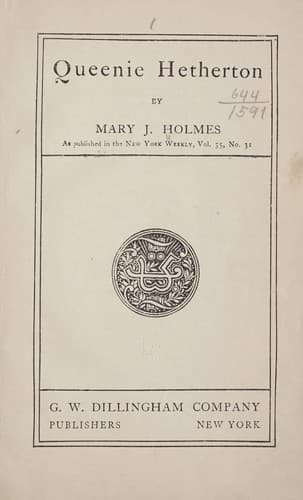
American fiction -- 19th century; Dime novels; Man-woman relationships -- Fiction; Upper class -- Fiction
like the parks of some of the old chateaus in France, with their
terraces, and winding walks, and pieces of statuary gleaming here and
there among the evergreens.
“A goodly heritage truly,” the woman said. “And would she give it all
for love? God only knows, and I can only know by trying. If she will see
me, I must go forward; if she refuses, I shall take it as a sign that I
must forevermore keep silent.”
Thus deciding, she walked quickly across the fields, and soon stood
ringing at the door, which was opened by Pierre himself.
“Miss Hetherton was still in her room,” he said, “but he would take any
message madame chose to give him;” and his manner showed plainly the
great distance he felt there was between his mistress and the woman who,
he knew, was born in the same rank of life as himself.
“Tell her Margery’s mother is here, and very anxious to see her,” Mrs.
La Rue said; and with a bow, Pierre departed, leaving her alone in the
hall.
He had not asked her to sit down, but she felt too faint and tremulous
to stand, and, sinking into a chair, leaned her head against the
hat-stand, and shutting her eyes, waited as people wait for some great
shock or blow which they know is inevitable. How long Pierre was gone
she could not guess, for she was lost to all consciousness of time, and
was only roused when he laid his hand upon her shoulder and demanded
what was the matter, and if she were sick. Then she looked up, and
showed him a face so white, so full of pain, and dread, and horror, that
he asked her again what was the matter.
“Nothing, nothing,” she answered, sharply. “Tell me what did she say?
Will she see me?”
“She bade me tell you she could not see you, but if your errand was very
particular or concerned Miss Margery, you were to give it to me,” Pierre
replied, and in an instant the whole aspect of the woman changed, the
deathly pallor left her face, and the look of dread and anguish was
succeeded by one of intense relief as she exclaimed:
“Thank God! thank God! for I could not have borne it. I could not have
done it at the last, and now I know it is not required of me. I have no
errand, no message; good-morning,” and she darted from the door, while
Pierre looked wonderingly after her, saying to himself, “I believe the
woman is crazy.”
And in good truth insanity would best describe Mrs. La Rue’s condition
of mind as she sped down the winding hills and across the causeway,
until the bridge was reached, and then she paused, and leaning far over
the railing looked wistfully down into the depths below, as if that
watery bed would be most grateful to her. Suicide was something of which
Mrs. La Rue had thought more than once. It was the phantom which at
times haunted her day and night, and now it looked over her shoulder and
whispered:
Public-domain text, read in full here on John Shaqi.
Reviews
Reviews
No reviews yet
Be the first to share your thoughts on this work.
Elsewhere in the archive
Join the Discussion
Join the discussion
Sign in to leave a comment or review.
Sign InorCreate an account