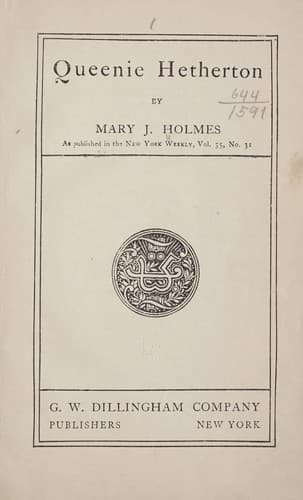
American fiction -- 19th century; Dime novels; Man-woman relationships -- Fiction; Upper class -- Fiction
“Why not end it now and forever? Better to die than live to ruin that
young life, and know yourself loathed and despised by the creature you
love best. Sometime in your fits of conscientiousness you will tell, as
you were tempted to do just now, and then——”
Mrs. La Rue gave a long, gasping shudder as she thought, “What then?”
and leaned still farther over the parapet beneath which the waters of
the Chicopee were flowing so sluggishly.
“Yes, better die before I am left to tell and see the love in Margery’s
face turn to bitter hatred. Oh, Margery, my child. Mine, by all that is
sacred! I cannot die and go away from her forever, for if there be a
hereafter, as she believes, we should never meet again. Her destiny
would be Heaven, and mine blackness and darkness of despair, where the
worm dieth not, and the fire is not quenched! She read me that last
night, little dreaming that I carry about with me the worm which dieth
not, and have carried it so many years, and oh, how it does gnaw and
gnaw at times, until I am tempted to shriek out the dreadful thing. Oh,
God, forgive me, and help me to hold my tongue, and keep the love of
Margery.”
She had drawn back from the railing by this time and, gathering her
shawl around her, she started for home, where she found Margery in the
reception-room alone, busily engaged on a dark-blue silk, which Anna
Ferguson had deigned to give her to make, and for which she was in a
hurry. She had been there that morning to see about it, and had found a
great deal of fault with some trimming which she had ordered herself,
and had insisted that the dress must be finished by twelve o’clock, as
she was going with Major Lord Rossiter to West Merrivale to see a
base-ball match on the Common.
“The match does not come off until four,” Margery said, “and if you can
give me till half-past two I shall be so glad.”
But Miss Anna was decided; she must have it at twelve, or not at all,
and when Margery asked if she would send for it, as the girl who usually
took parcels home was sick, she answered promptly;
“No, it is not my business to do that.”
And Margery bore the girl’s insolence quietly, and promised that the
dress should be done, and put aside Mrs. Col. Markham’s work to do it,
because she knew Mrs. Markham was a lady and would not insult her if she
chanced to be disappointed. But she felt the ill-bred girl’s
impertinence keenly, and her cheeks were unusually red, and her lips
very white, when her mother entered the room, and, bending over her,
kissed her with a great, glad tenderness as we kiss one restored to us
from the gates of death.
“You look tired and worried, _ma petite_,” she said, “and you are
working so fast. I thought that dress was not to be finished till
to-morrow.”
Public-domain text, read in full here on John Shaqi.
Reviews
Reviews
No reviews yet
Be the first to share your thoughts on this work.
Elsewhere in the archive
Join the Discussion
Join the discussion
Sign in to leave a comment or review.
Sign InorCreate an account