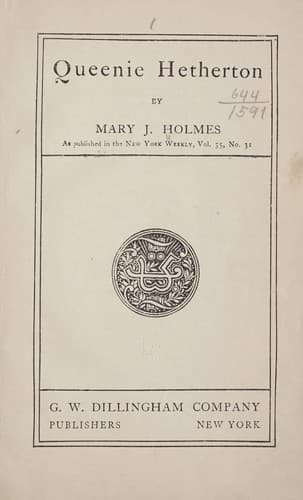
American fiction -- 19th century; Dime novels; Man-woman relationships -- Fiction; Upper class -- Fiction
“I wonder why she asks me so often if I love her and am happy? Maybe I
do not show her my affection enough. I am not demonstrative, like her;
there’s very little of the French gush in me. I am more like the cold
Americans, but I mean to do better and pet her more, poor, dear mother,
she is so fond and proud of me,” Margery thought, as she kept on with
her work, while her mother busied herself in the kitchen, preparing the
cup of nice hot tea and slice of cream toast which at twelve she carried
to her daughter, who could not stop for a regular meal.
The navy-blue was at a point now where no one could touch it but
herself, and she worked steadily on until after one, when Anna again
appeared, asking imperiously why the dress was not sent at twelve, as
she ordered.
“Because it was not done,” Margery replied, adding, “It is a great deal
of work to change all that trimming as you desired.”
“It ought not to have been made that way in the first place,” Anna
rejoined, and then continued, “I must have it by two at the latest, and
will you bring it yourself, so as to try it on me and see if it hangs
right?”
“Yes, I’ll bring it,” Margery said, and an hour later she was trudging
along Cottage Row with a bundle almost as large as herself, for the
dress had many plaitings, and puffs, and bows, and must not be crushed
by crowding into a small space.
But Margery did not feel one whit degraded or abased, even though she
met Mr. Beresford fade to face, and saw his surprise at the size of the
bundle. Mr. Beresford was the only man who had ever interested Margery
in the least, and she often wondered why she should feel her blood stir
a little more quickly when she saw him. He was so proud, and dignified,
and reserved, though always a gentleman and courteous to her, and now he
lifted his hat very politely, and, with a pleasant smile, passed on,
thinking to himself how beautiful the French girl was, and what a pity,
too, that she had not been born in the higher ranks of life, with such
people as the Rossiters, and Hethertons, and Beresfords.
Miss Anna was waiting impatiently, and all ready to step into her dress,
which fitted her perfectly, and was so becoming, and gave her so much
style that she condescended to be very gracious and familiar, and as she
looked at herself in the glass, she said:
“Why, _La Rue_, you are a brick; how lovely it is! I have not a word of
fault to find!”
“I am glad if it suits you. Good-afternoon, Miss Ferguson,” Margery
said, quietly, and then walked away, while Anna thought:
“If she were a grand duchess she could not be more airy. I wonder who
she thinks she is, any way? Queenie has just spoiled her with so much
attention, and she only a dressmaker!”
CHAPTER XXIX.
LETTERS FROM MENTONE.
Public-domain text, read in full here on John Shaqi.
Reviews
Reviews
No reviews yet
Be the first to share your thoughts on this work.
Elsewhere in the archive
Join the Discussion
Join the discussion
Sign in to leave a comment or review.
Sign InorCreate an account