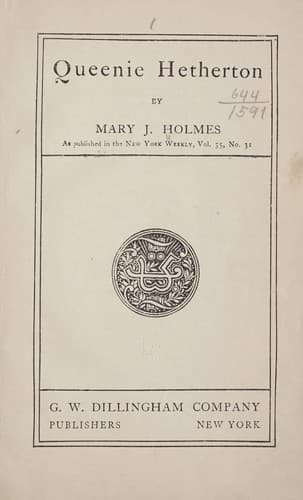
American fiction -- 19th century; Dime novels; Man-woman relationships -- Fiction; Upper class -- Fiction
“Nor was it,” Margery answered, “but Miss Ferguson has been here and
insists upon having it at twelve, and she was so overbearing, and found
so much fault, and made me feel so keenly that I was only her
dressmaker, that I am a little upset, even though I know she is not
worth a moment’s disquietude.”
“Poor Margery! It is to the caprices of such people as she that you are
subjected because you are poor,” Mrs. La Rue said, caressing the golden
head bent so low over Anna’s navy-blue, on the sleeve of which a great
tear came near falling. “You ought to be rich, like Miss Hetherton. You
would be happier in her place, would you not, my child?”
“No, mother,” and Margery’s beautiful blue eyes looked frankly up into
her mother’s face. “I should like money, of course, but I am very happy
as I am except when people like Anna insult me and try to make me feel
the immeasurable distance there is between themselves and a dressmaker.
I like my profession, for it is as much one as that of the artist or
musician, and if I were rich as Queenie I do believe I should still make
dresses for the love of it. So, mother mine, don’t bother about me. I am
very happy—happier far, just now, than Queenie, who, though she may have
riches in abundance, has no mother to love her, and care for her, and
pet her, as I have.”
“Oh, Margery, child, you do love me, then you are glad I am your mother,
unlike you as I am?” Mrs. La Rue cried in a voice which was like a sob
of pain, and made Margery look wonderingly at her, as she said:
“Why, mother, how strangely you act this morning. Of course I am glad
you are my mother—the dearest and kindest a girl ever had. I cannot
remember the time when you would not and did not sacrifice everything
for me, and why should I not love you?”
“You should, you ought,” Mrs. La Rue replied, “only you are so different
from me that sometimes when I think how refined and lady-like you are,
and then remember what I am—an uneducated peasant woman—I feel that I am
an obstacle in your way, and that you must feel it, too, and wish you
were some one else—somebody like Miss Hetherton—but you don’t, Margery,
you don’t.”
“Of course I don’t,” Margery answered, laughingly, “for if I were Miss
Hetherton, don’t you see, Anna would be my cousin, and that would be
worse than a hundred peasant women; so, little mother, don’t distress
yourself or bother me any more, for my Lady Anna must have her dress by
twelve, and it is nearly eleven now.”
Taking the girl’s lovely face between her hands Mrs. La Rue kissed it
fondly, and then left the room, while Margery wondered what had happened
to excite her so. Such moods, or states of mind, in her mother were not
unusual, and since coming to Merrivale they had been more frequent than
ever, so Margery was accustomed to them, and ascribed them to a
naturally morbid temperament, combined with a low, nervous state of
health.
Public-domain text, read in full here on John Shaqi.
Reviews
Reviews
No reviews yet
Be the first to share your thoughts on this work.
Elsewhere in the archive
Join the Discussion
Join the discussion
Sign in to leave a comment or review.
Sign InorCreate an account