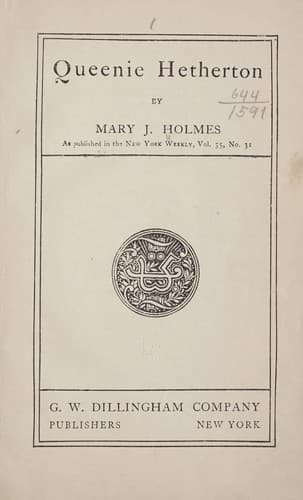
American fiction -- 19th century; Dime novels; Man-woman relationships -- Fiction; Upper class -- Fiction
They were of mutual benefit to each other—this mistress and maid, for
while Christine anticipated every wish of Margaret, waiting upon her as
if she had been a duchess, and teaching her the French language as well
as the German, of which she had some knowledge. Margaret in turn taught
her a little English, and during the many weeks when she was alone and
her husband away with his friends, she gave her lessons in history, and
geography, and arithmetic, so that Christine, who was apt and bright,
became a much better scholar than was common to persons of her class,
and astonished her mistress with her rapid improvement. Even Mr.
Hetherton began to notice her at last and marvel at the change in her,
and when he was home he often found himself lingering longer in his
wife’s apartments when Christine was there, with her saucy smile, her
bright eyes, and her pretty way of saying things. Without any motive
except that she wished to please him because he was madame’s husband she
made herself necessary to him, and, carefully studying his wishes,
ministered to him with the alacrity of a slave, and when he offered her
money for extra services she refused to take it, and said that what she
did was done for love of him and madame, who trusted and clung to the
girl with a love which made the poor woman shiver with remorseful pain,
as she remembered it now, when the sins of the past were confronting her
so fearfully, and making her almost shriek aloud, as she recalled those
days in Rome, when the husband was seeking his own pleasure, while the
wife grew paler and thinner each day, and yet strove so hard to keep up,
by talking of the great happiness in store for her, and surprise for
him, if all went well with her, and she lived through the trial awaiting
her.
“Frederick is so fond of children, and he will be so happy and surprised
when he hears of it. I am glad I did not tell him,” she said, when at
last the waiting and suspense were over, and a little girl baby was
pillowed on her arm.
Christine could see that baby now, and feel the touch of its soft hands,
and see the white, worn face upon the pillow, and the great blue eyes
which followed her so wistfully and questioningly, and at last had in
them a look of terror and dread, as the days went by and no strength
came to the feeble limbs, or vitality to the nerves. She was dying, and
she knew it at last, and throwing herself into Christine’s arms, she
sobbed like a little child.
“It is hard to die,” she said, “when I am so young and have so much to
live for, now baby is born. And home is so far away, and mother, too,
and Frederick—where is he, Christine? He ought to be here, and I so sick
and lonely.”
Christine knew that very well, and her tears fell like rain upon the
golden head resting upon her bosom, while she tried to comfort the young
mother, who was so surely passing away.
Public-domain text, read in full here on John Shaqi.
Reviews
Reviews
No reviews yet
Be the first to share your thoughts on this work.
Elsewhere in the archive
Join the Discussion
Join the discussion
Sign in to leave a comment or review.
Sign InorCreate an account