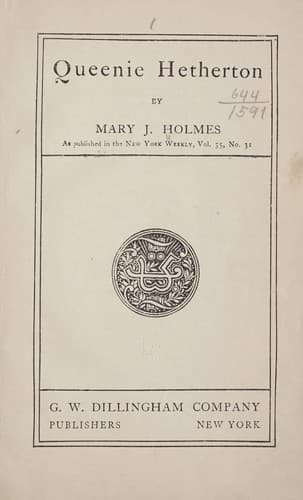
American fiction -- 19th century; Dime novels; Man-woman relationships -- Fiction; Upper class -- Fiction
“Monsieur must come soon,” she said; “and then madame will be better,
and we shall go back to Chateau des Fleurs and be so happy there.”
But Margaret knew better. She would never go to Chateau des Fleurs—never
see her husband again, and that grieved her the most, for all his
neglect and coldness had not killed her love, and she longed for him now
so much when she lay dying in Rome, with only her baby and Christine
with her—Christine, to whom she said “God bless you, and reward you
according to your kindness and faithfulness to me!”
Margaret had meant it for a blessing, but it was really a curse, and it
had followed Christine ever since, until now, when her sin was finding
her out, and making her writhe with anguish and fear.
“And yet I was kind to her,” she whispered; “and she died in my arms,
with her head upon my breast, and she kissed me twice upon my lips; one
was for me, she said, and one for the baby when she was old enough to
know. Ah, me, those kisses! how they burn like fire! and I am burning,
too—burning! Is there a hell, I wonder, and is it worse than the torment
I am enduring?”
Her mind was disordered, and she raved incoherently of Rome, and Chateau
des Fleurs; and Paris, and Margaret, and Reinette, until she was utterly
exhausted, and growing quiet, at last fell into a sleep so deep that she
did not hear Margery when she let Mr. Beresford out and came up to her
room.
“Poor mother, she is resting sweetly, and I hope will be better
to-morrow,” Margery said, as she bent over the sleeping woman, whose
face looked so white, and worn, and pinched.
The next morning, however, Mrs. La Rue did not attempt to get up. She
was too weak and sick, she said, and should keep her bed all day. “And
Margery,” she added, with quivering lip and a pleading tone, “don’t let
any one in here, will you, if they come asking for me? Not any one;
promise, Margery.”
“No, mother, no one shall disturb you,” Margery said, soothingly, “and
fortunately I have not much work on hand to-day, and can stay with you a
great deal. I must finish Miss Ferguson’s sacque, and that is all. Now
try to sleep again. I can’t have such a woeful-looking, pale-faced
little mother on my hands. I shall have to send her off and get another
one.”
She spoke playfully, but every word was a stab to the miserable woman,
who said again:
“Remember, Margery, nobody is to come up here.”
“No, mother, nobody. You are safer than the old bishop in his castle on
the Rhine, for the rats did reach him there, and not so much as a mouse
shall harm you here, so _au revoir_,” and with a kiss—the last—the very
last, she would ever give as she gave that, she ran down stairs just as
a carriage stopped at the gate and Reinette came rapidly up the walk.
CHAPTER XXXIII.
REINETTE’S INTERVIEW WITH MARGERY.
Public-domain text, read in full here on John Shaqi.
Reviews
Reviews
No reviews yet
Be the first to share your thoughts on this work.
Elsewhere in the archive
Join the Discussion
Join the discussion
Sign in to leave a comment or review.
Sign InorCreate an account