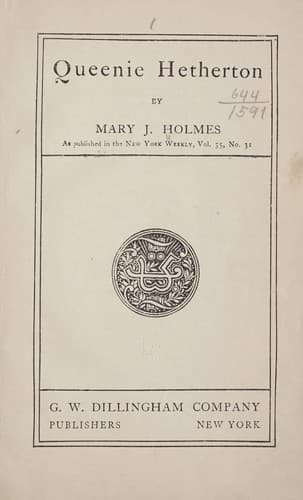
American fiction -- 19th century; Dime novels; Man-woman relationships -- Fiction; Upper class -- Fiction
Reinette did not ring, but entered unannounced, like one who had but one
thought, one purpose, and was resolved to carry it out with as little
ceremony as possible. It was fortunate for all parties that this was
Margery’s dull season, and there were no girls there with prying eyes
and curious ears to listen, for Reinette was greatly excited now that
the moment drew near when she could confront Christine, and she plunged
at once into business by saying to Margery, “Where is your mother? I
have come to see her.”
“Mother is sick,” Margery replied; “she is very nervous and cannot see
any one. I am sorry, but you will have to wait. Maybe I can do as well,”
she continued, looking wonderingly at Queenie, who, utterly disregarding
what she said, had started for the stairs.
“No, you will not do as well. I must see her; it is very important and I
cannot wait,” Queenie said, still advancing toward the stairs, while
Margery put herself between them and her friend, whose strange conduct
surprised her so much.
“But you cannot see her. I promised no one should disturb her,” she said
again, and now she laid her hand on Queenie’s shoulder to detain her,
for Queenie’s foot was on the first stair and she looked resolute enough
to storm a fortress as she persisted in her determination to go up.
But not less resolute than her own was the face which confronted her as
Margery roused up and said in a voice Queenie had never heard from her
before: “Miss Hetherton! You astonish me. I tell you mother is sick and
cannot be disturbed. You must not go up.”
“And I tell you I _must_. I have important news from Mentone, which
concerns your mother and me, and I must see her.”
“What news?” Margery asked, thinking suddenly of the letter her mother
had received from Mentone the previous night, and experiencing a vague
feeling of fear and dread of some impending evil. “What news have you
heard which concerns my mother?” she repeated, looking steadily at
Reinette.
Reinette hesitated a moment, kept silent by something in Margery’s face,
but when she said for the third time, “Tell me what news you have
received from France,” she replied: “Margery, it shall never make any
difference between us, but your mother is Christine Bodine, whom I have
been trying to find.”
“My mother Christine Bodine! Impossible! She was Marie La Mille,”
Margery gasped, as she clutched Reinette’s shoulder with a grip which
was painful.
“I have it from her agent in Mentone, who has received money for her at
different times from Messrs. Polignie in Paris—money my father deposited
for her with them years ago. Now let me go! I _must_ see her!” Queenie
said, darting up the stairs, no longer restrained by Margery, who had
let her pass without further protest.
Public-domain text, read in full here on John Shaqi.
Reviews
Reviews
No reviews yet
Be the first to share your thoughts on this work.
Elsewhere in the archive
Join the Discussion
Join the discussion
Sign in to leave a comment or review.
Sign InorCreate an account