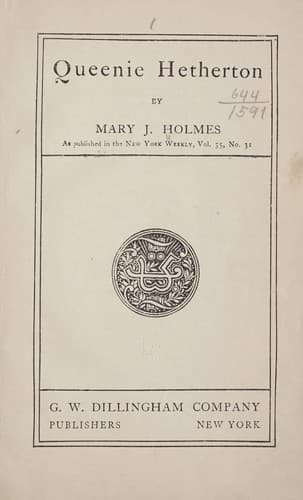
American fiction -- 19th century; Dime novels; Man-woman relationships -- Fiction; Upper class -- Fiction
“You don’t know why you didn’t tell me? That is very strange,” Reinette
replied. “If there is nothing to conceal, if all your dealings with my
parents were honorable and upright, I see no reason for hiding from me
the fact that you were once my nurse. Christine, I did not come to
quarrel with you,” and Reinette’s voice softened a little. “I have loved
you too much for that, but I have come to hear about my mother. You were
with her when she died. You nursed me when I was a baby. You know what
mother said to me and of me. She loved you, Christine, and trusted you.
I have it in a letter written to my father before she died, when he was
away in Russia or Austria. And that is why he paid you money, was it
not, Christine?”
She was looking fixedly at the woman on whose white face blood-red spots
were beginning to show, and who answered falteringly:
“Yes, that is why he gave me the money. Oh, Reinette, leave me; go away;
don’t try to unearth the past. There are things you should not
know—things I cannot tell. God help me. I wish I had died before I ever
saw your face.”
She looked so pale and death-like that Reinette bent anxiously over her,
and bringing the camphor bathed her forehead, and held it to her
nostrils until she was better, and raising herself from the pillows upon
which she had fallen, she said:
“I cannot lie here. I feel that I am smothering. I must get up, while I
talk to you, but oh, you’ll be so sorry. You’ll wish you had never come.
Bring me my wrapper there on the chair, and my woolen shawl, for I am
shivering with cold.”
Her teeth were chattering, and her lips were blue and pinched as Queenie
brought the wrapper and helped her put it on, kneeling on the floor to
button it herself, and occasionally speaking soothingly to her, though
her own heart was beating rapidly with a dread of what she might hear.
Then it was that Margery appeared on the scene, and by suggesting that
no one but themselves need know what had so long been hidden, changed
Mrs. La Rue’s intentions altogether. For a few brief moments there had
been in her mind a resolve to make a clean breast of it, and to tell the
truth, and then when that was done, she would kill herself, and so
escape the storm sure to follow her revelations.
“Better die,” she thought, “than live to be questioned and suspected by
the Rossiters, and Fergusons, and everybody, as I should be if they knew
I was Christine.”
But when the idea was suggested that only Margery and Reinette need
know, she changed her mind, and in what she would now tell the latter,
there was to be a deep, dark gulf bridged over in silence.
“Help me to my chair. I am very, very weak,” she said to Reinette, when
Margery had gone.
Reinette complied with her request, and leading her to a chair placed
her gently in it, and drew the shawl closer around her. At this little
act of attention Christine broke down entirely, and throwing her arms
around Reinette, sobbed out:
Public-domain text, read in full here on John Shaqi.
Reviews
Reviews
No reviews yet
Be the first to share your thoughts on this work.
Elsewhere in the archive
Join the Discussion
Join the discussion
Sign in to leave a comment or review.
Sign InorCreate an account