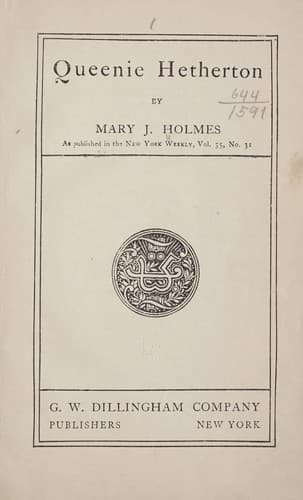
American fiction -- 19th century; Dime novels; Man-woman relationships -- Fiction; Upper class -- Fiction
“Oh, my darling, my baby whom I nursed. I have so longed to hold you in
my arms as I held you years ago. Reinette, Reinette, kiss
me—because—because—I am—Christine.”
It was not in Reinette’s nature to resist such an appeal, and she kissed
the poor trembling woman twice, and then drawing a chair to her side
spoke very softly to her, and said:
“Now tell me.”
“Tell you what, child? What do you wish most to know?” Christine asked,
and Reinette replied:
“About my mother. You are the first I have ever seen who knew her after
she was Mrs. Hetherton. I have heard what she was when a girl—the
sweetest, loveliest creature, they say, with eyes like the summer sky,
and a face so fair and pure, and I wish to hear from beginning to end
all you know about her, and when you saw her first, and where, and about
her death in Rome, when I was born, and only you there to care for
either of us.”
“Would you mind holding my hand while I tell you of my first days with
Mrs. Hetherton?” Christine said, and Reinette took the cold, clammy hand
between both of hers and rubbed and chafed it as tenderly as Margery
herself would have done.
She was beginning to feel very kindly toward this woman who had known
her mother; the insinuations in Messrs. Polignie’s letter were forgotten
for the time, and she saw before her only one who had cared for her when
an infant and had seen her mother die.
“Begin,” she said, “I am impatient to hear.”
And so Christine began, and told her of the advertisement for a waiting
maid, which she had answered in person; told her of the handsome rooms
at the Hotel Meurice, and of the beautiful young lady who was so kind to
her, and made her more a companion than a maid, notwithstanding that her
proud husband frequently protested against it and talked of bad taste,
which sometimes made madame cry.
“And did she tell you of Merrivale and her old home? Did you know she
was an American?” Queenie asked, and Mrs. La Rue replied:
“Yes, she told me all about her home and Merrivale, and I was familiar
with every rock, and hill, and tree, I think, especially the elms upon
the common, and the poplars near her home. She was so fond of Merrivale
and her friends, and used often to cry for the mother so far away.”
“Was she very homesick?” Reinette asked, and Mrs. La Rue answered her:
“At times, yes, when monsieur was away with his associates, or staid out
so late nights, as he sometimes did.”
Reinette’s breath came quickly for a moment, and her voice shook as she
asked, very low, as if afraid some one might hear:
“Was not father kind to her always?”
“If beautiful dresses and jewelry, and horses and carriages, and plenty
of money means kindness, then he was kind, for she had all these in
profusion, but what she wanted most she did not have, and that was her
husband’s society,” Mrs. La Rue said, and then Reinette drew back a
little haughtily and answered:
Public-domain text, read in full here on John Shaqi.
Reviews
Reviews
No reviews yet
Be the first to share your thoughts on this work.
Elsewhere in the archive
Join the Discussion
Join the discussion
Sign in to leave a comment or review.
Sign InorCreate an account