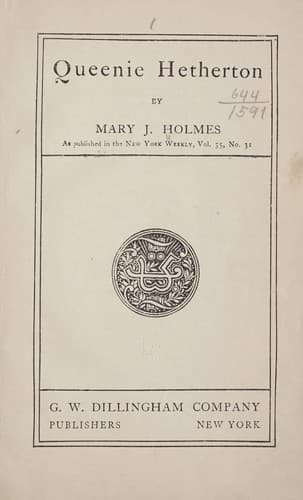
American fiction -- 19th century; Dime novels; Man-woman relationships -- Fiction; Upper class -- Fiction
So Christine went on and told of the long hours when the dying woman lay
with her baby clasped to her bosom, and her head pillowed on the strong
arm of her maid, who held her thus until the darkness was passed and the
early dawn of the mild spring morning began to creep into the room, when
Margaret roused a little, and said:
“It is almost over, Christine. I am going home to Jesus, whose arms
are around me so that I am not afraid. Tell them at home I was so
happy, and death had no terror for me. Tell them I seem to hear the
children singing as they used to sing in the old church in Merrivale,
and the summer wind blows in and out, and brings the perfume of the
pond lilies with it, and the river flows on and on amid the green
meadows—away—away—just as I am floating so quietly out upon the sea of
eternity, where the lilies are fairer and sweeter than those which
lift their white heads to the sunshine in the ponds of Merrivale. And
now, Christine, place my baby so I can kiss her once more, for sight
and strength have failed me.”
The child’s face was lifted to the pale lips which kissed it tenderly,
and then, just as the warm Italian sunshine lighted up the distant dome
of St. Peter’s with a blaze of gold, and all over the great city, and
far out upon the Campagna the morning was warm and bright, the young
mother lay dead in the silent room, with only her servant and baby with
her.
There was a fresh burst of tears and sobs from Reinette as she listened
to the story, and when it was ended she threw her arms around her
nurse’s neck and nearly strangled her with kisses, as she said:
“I can forgive you everything now that I know how good and true you were
to my mother.”
With something like a moan Christine freed herself from the girl, and
went rapidly on:
“I did not know just where your father was, for he was never long in the
same place, and as we could not wait to hear from him, and I did not
know what to do, strangers took the matter in hand and buried her in the
Protestant grave-yard at Rome, where you father has never been since.”
“And I?” Reinette said. “You took me to him?”
“Yes, I took you to Chateau des Fleurs,” Christine replied, while her
face grew scarlet and then turned ashen pale, and Queenie never dreamed
of the chasm which she leaped in silence, or of the bitter remorse which
brought those livid spots to the face of Christine, who did not look at
her now, but shut her eyes and leaned wearily back in her chair.
“I am so weak, and talking all this tires me so,” she said; but Reinette
was not satisfied, and her next question was:
“What did father say when he first saw me?”
Christine did not reply to this, but sat with her hands locked together,
and a look upon her face as if she was living over some painful scene.
“Tell me; how did he act? What did he say?” Reinette repeated, and then,
with a smile full of irony and bitterness Christine answered:
“He _swore_ because you were not a boy!”
Public-domain text, read in full here on John Shaqi.
Reviews
Reviews
No reviews yet
Be the first to share your thoughts on this work.
Elsewhere in the archive
Join the Discussion
Join the discussion
Sign in to leave a comment or review.
Sign InorCreate an account