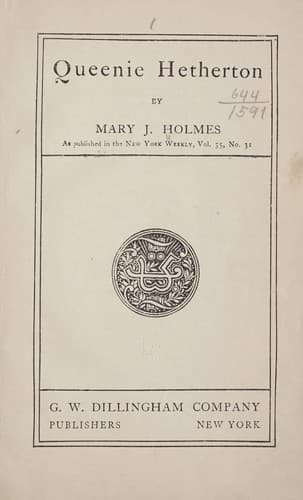
American fiction -- 19th century; Dime novels; Man-woman relationships -- Fiction; Upper class -- Fiction
Here Christine stopped suddenly and covering her face with her hands
sobbed hysterically as she recalled that scene, while Reinette, too,
cried as she had never cried before for the dying mother in Rome, who
had held her babe to the very last and prayed that God would bless it
and have it in his keeping and make it a comfort and a joy to the
husband and father, who was far away, joining in a midnight revel where
wine, and cards, and women, such as Margaret Ferguson never knew, formed
a conspicuous part.
“Her baby was a great comfort to her,” Mrs. La Rue said, when she could
speak, “and she would have it where she could feel its little hands upon
her face, even after blindness came upon her, and she could no longer
see. The English physician had been in, and told me she probably would
not last the night through, and that I must have some one with me. But
she said, ‘No; Christine and baby are all I want,’ and when he was gone
she made me sit by her, while she talked, as she had done many a time,
of her home over the sea, of her sister, and her mother, to whom she
sent messages. I remember her very words. ‘Tell them,’ she said, ‘that I
have never ceased to love them, and to long for them with such longing
as only homesick creatures know, and if I have seemed neglectful, and
have not written as I ought it was because—I couldn’t. I can’t explain,
only I love them so much; and now if I could lay my head on mother’s
lap, as I did when I was a little girl, and it ached as it is aching
now, I should die more willingly. Dear old mother! poor old father! with
his hard, brown hands, which have worked so hard for me—God bless them,
and comfort them, when they hear I am dead!’”
“Oh, Christine!” Reinette sobbed, “grandma ought to know this—she and
Aunt Mary, too. They have never heard one word of her last days, for
father only wrote that she was dead, and did not even tell them of my
birth. I ought to tell my grandmother; she will be so glad to know.”
“No, no! oh, no! better not. You said you would not!” Christine
exclaimed in terror. “It would lead to so much talk—so many questions
about your father, and—Reinette, forgive me—but his record was not the
fairest. Even you, his daughter, would not like to see its blackest
pages.”
Reinette’s face was crimson with shame and resentment, and in her eye
was that peculiar gleam which so bewildered and confounded those on whom
it fell. The fair structure she had built about her father’s memory was
tottering to atoms, but she would struggle bravely to keep it together
as long as possible, and she replied:
“If there were pages so black in father’s life, do not show them to me,
lest I should say you told me falsely. He was my father, and I loved him
so dearly. He was kind to me always—and I will stand by him forever. But
you have not finished. I want to know just how mother died.”
Public-domain text, read in full here on John Shaqi.
Reviews
Reviews
No reviews yet
Be the first to share your thoughts on this work.
Elsewhere in the archive
Join the Discussion
Join the discussion
Sign in to leave a comment or review.
Sign InorCreate an account