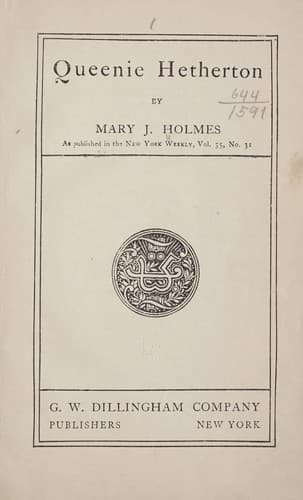
American fiction -- 19th century; Dime novels; Man-woman relationships -- Fiction; Upper class -- Fiction
“Leave me now, please; there is nothing more to tell, and I am so tired
and sick, and—and—there is Margery yet to see. Oh, Miss Hetherton, make
it easy as you can to Margery. Don’t let her think ill of me. I could
not bear that. I would rather have the bad opinion of the whole world
than hers. She is so good, so true, and hates deception so much. Go now,
and leave me to myself. I believe—I think—yes, I am sure I am going
mad.”
Reinette looked at her in surprise.
“There is something else,” she thought, “something behind, which she has
not told, and I mean to know what it is; but I will leave her now,” and
taking Christine’s hot hands in hers she said, very kindly, “Good-by,
Christine; I am going, but another time you will tell me more of my
mother.”
Then pressing her hand to her lips she ran down the stairs to Margery,
who was waiting anxiously for her, and who for the first time in her
life was glad when Reinette said good-by and left her alone to seek her
mother.
CHAPTER XXXV.
MARGERY AND HER MOTHER.
For a full quarter of an hour after Reinette’s departure Margery sat
motionless, with her head bent down, thinking of all the incidents of
her past life as connected with her mother, and recalling here and there
certain acts which, viewed in the new light shed upon them, seemed both
plain and mysterious. Buzzing through Margery’s brain, and almost
driving her mad, was the same suspicion which had at times so disturbed
Reinette, but, like Reinette, she fought it down. But not for the dead
man whose costly monument was gleaming cold and white in the grave-yard
of Merrivale. He was nothing to her, save as the father of her friend,
who, for his daughter’s sake, had been kind to her so far as money was
concerned. But it was for the woman up stairs, her mother, that her
heart was aching so, and the hot blood pouring so swiftly through her
veins. To lose faith in her whom she had believed so good, and who had
taught her always that truth and purity were more to be prized than all
the wealth in the world, would be terrible. And yet that mother’s life
had for years been one of concealment, for which she could see no
excuse. That given to Queenie was not the true reason. There was
something else, “and I must know what it is,” she thought, “even if it
kills me.”
Starting to her feet at last, and forgetting how weak and sick her
mother was, she went half way up the stairs and called:
“Mother, will you come down, or shall I come up?”
The voice was not the same which Mrs. La Rue knew as Margery’s. There
was a hardness and sternness in it which boded no good to her, and a
mortal terror took possession of her as she thought:
“My hour has come. She will wring it from me. Well, no matter. It will
be better for her, perhaps.”
“Say, mother, will you come down, or shall I come up?” came again from
Margery, and this time Mrs. La Rue replied:
Public-domain text, read in full here on John Shaqi.
Reviews
Reviews
No reviews yet
Be the first to share your thoughts on this work.
Elsewhere in the archive
Join the Discussion
Join the discussion
Sign in to leave a comment or review.
Sign InorCreate an account