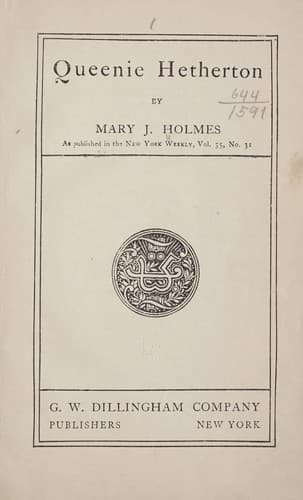
American fiction -- 19th century; Dime novels; Man-woman relationships -- Fiction; Upper class -- Fiction
“Oh, Margery, Margery! not yet—not yet! Spare me a little longer. I have
been so tried and worried. I am not quite right in my head; wait awhile
before you come, dear Margery.”
There was a world of pathos in those two words—“dear Margery”—pathos and
pleading both, as if the mother were asking mercy from her child. And
Margery recognized the meaning, but her heart did not soften or relent.
Indeed, she could not understand herself, or define the strange feeling
which had taken possession of her and was urging her on to know what it
was her mother had hidden so long and so successfully.
But she did not then go up; she waited awhile, and going to the kitchen,
prepared a tempting dinner, which she arranged upon a tray, and then
took to the room, where Mrs. La Rue still sat just as Reinette had left
her, her face as white as marble, her eyes blood-shot and dim, and her
whole attitude that of a guilty culprit awaiting its punishment.
And she was awaiting hers, and when the first blow came in the person of
Margery bringing her the nicely-prepared dinner, she seemed to shrivel
up in her chair, and her head dropped upon her breast. But she did not
speak, and when Margery drew a little table to her side, and placing the
tray upon it, poured out her tea and held it to her lips, she swallowed
it mechanically, as she did the food pressed upon her. At last, however,
she could take no more, and putting up her hand, she made a gesture of
dissent, and whispered faintly:
“Enough!”
How sick and old, and crushed she looked! But for this Margery would not
spare her; and when, after taking the dinner away, she returned to her
mother, and sat down where Queenie had sat, she said:
“Now, tell me.”
“Tell you what?” Mrs. La Rue asked, and Margery replied.
“Tell me the whole truth, every word of it, as you did not tell it to
Queenie.”
“What did I tell her?” Mrs. La Rue said, in a bewildered kind of way, as
if the events of the last few hours were really a blank to her.
“You told her you were Christine Bodine, her former nurse,” Margery
began, and her mother interrupted her with:
“And I am, Margery; that was the truth. I was Christine Marie La Mille
Bodine; but I dropped the first name and the last, and for years was
only Marie La Mille.”
“Yes, I know,” Margery returned. “You deceived me with regard to your
name, and you kept your identity a secret from Reinette when you knew
how much she wished to find you, and you gave her as a reason that you
feared lest she would think less of me if she knew I was the child of
one who had once served her mother.”
“Yes, that’s it—that’s it, Margie!” Mrs. La Rue gasped, as she clutched
the skirt of Margery’s gown and rubbed it caressingly.
“Mother,” Margery said, and her voice was low and stern, “that excuse
might do for Queenie, but not for me, who knows all our past life. There
is something you are keeping from me, and which I must know. What is it?
Why were you afraid to let Queenie know who you were?”
Public-domain text, read in full here on John Shaqi.
Reviews
Reviews
No reviews yet
Be the first to share your thoughts on this work.
Elsewhere in the archive
Join the Discussion
Join the discussion
Sign in to leave a comment or review.
Sign InorCreate an account