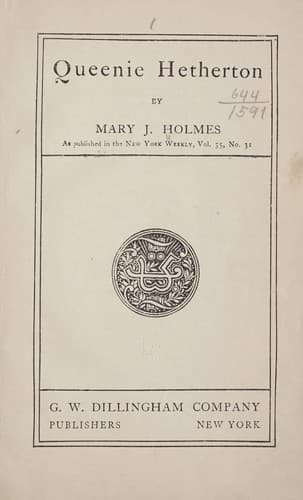
American fiction -- 19th century; Dime novels; Man-woman relationships -- Fiction; Upper class -- Fiction
“There is nothing—nothing—believe me, Margie, nothing,” Mrs. La Rue
said, still caressing the gown, as if she would thus appease her
daughter, who continued:
“Yes, there is something; there has been a _something_ always since I
can remember. I see it now—your fits of abstraction, your moods of
melancholy, amounting almost to insanity, and which have increased in
frequency since we came to America and met Reinette. The money you
received at stated times was from her father, was it not?”
“Ye-es,” came in a whisper from Mrs. La Rue’s white lips, and Margery
went on:
“You must then have always known his whereabouts. When we lived in
Paris, and father was alive you knew that Mr. Hetherton was there in the
city, too; and did you ever see him?”
“Never—never! He would have spurned me like a dog,” Mrs. La Rue
answered, energetically, and Margery continued:
“But you knew he was there, and when Queenie came to me that day when I
wore her scarlet cloak and she my faded plaid, you knew who she was, and
did not speak?”
“Yes, I knew who she was, and did not speak,” moaned Mrs. La Rue, and
Margery went on:
“And when I was at school with her, and her father paid the bills, and
when I visited her at the chateau, you knew, and did not tell me. But
did you tell my father? Did he know who Queenie was?—know of Mr.
Hetherton?”
“No, he did not,” Mrs. La Rue replied, “nor was it necessary. I was a
faithful wife to him, and there was no need for him to know.”
“Mother,” Margery began, after a moment’s pause, “why did you wish to
hide from Queenie who you were? I have a right to know. I am your
daughter, and if there has been any wrong I can share it with you. I
would rather know the exact truth than think the horrible things I may
think, if you do not tell me. Why did you take another name than your
own, and why did you not reveal your self to Queenie, but leave her to
grope in the dark for what she so much wished to find? Tell me. I insist
upon knowing.”
Driven to the last extremity, and forgetting herself in her distress,
Mrs. La Rue replied:
“I had sworn not to do it; had taken a solemn vow never to let Queenie
know who I was.”
“Had made a vow? Had sworn not to do it? Who made you swear? Who
required that vow from you? Was it Mr. Hetherton?” Margery asked, and
her mother replied:
“Yes, Mr. Hetherton; curse him in his grave! He has been my ruin. I was
so happy and innocent until I knew him. He wrung the vow from me: he
paid me money to keep it; he——”
She stopped here, appalled by the look on Margery’s face—a look which
made her cower and tremble as she had never trembled and cowered before.
Wrenching her dress away from the hands which still held it, and drawing
herself back, Margery demanded:
Public-domain text, read in full here on John Shaqi.
Reviews
Reviews
No reviews yet
Be the first to share your thoughts on this work.
Elsewhere in the archive
Join the Discussion
Join the discussion
Sign in to leave a comment or review.
Sign InorCreate an account