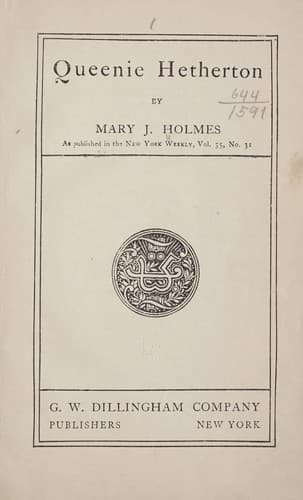
American fiction -- 19th century; Dime novels; Man-woman relationships -- Fiction; Upper class -- Fiction
I be happy with Phil dead in the sea?”
She was beginning to soften; the mood was passing off, and though her
face was pale as ashes, the glitter was gone from her eyes, which turned
at last toward Margery, who had looked on in utter astonishment.
“Oh, Margie, Margie, help me. I don’t know what I have been saying. I
think I must be crazy,” she said, as she stretched her arms towards
Margery, who went to her at once, and leading her to the couch made her
lie down while she soothed and quieted her until a faint color came back
to her face, and her heart-beats were not so rapid and loud.
Across the room by the window Mr. Beresford was still standing, with a
troubled look upon his face, and seeing him Queenie called him to her,
and putting her icy hand in his, said to him very gently:
“Forgive me if I have wounded you. I am not myself when these moods are
upon me. I don’t know what I said, for my heart is with Phil, and Phil
is in the sea. Now go away, please, and leave me alone with Margie.”
Mr. Beresford bowed, and pressing the hand he held, said, in a choking
voice:
“God bless you, Queenie, and comfort you, and forgive me if anything I
said was instrumental in sending Phil away. He was the dearest friend I
ever had, the one I liked the best and enjoyed the most, and I never
shall forget him or cease to mourn for him. Good-by, Queenie;
good-afternoon, Miss La Rue.”
He bowed himself from the room, and was soon riding slowly homeward,
with sad thoughts in his heart of the friend he had lost and who seemed
to be so near him that more than once he started and looked around as if
expecting to meet Phil’s pleasant face and hear his well-remembered
laugh. Mr. Beresford belonged to that class of men, who, without exactly
saying there is no God and no hereafter, still doubt it in their hearts,
and by trying to explain everything on scientific principles, throw a
vail over the religion they were taught to hold so sacred in their
childhood. But death had never touched him very closely, or borne away
that for which he mourned with a very keen or lasting sense of loss and
pain. His father had died when he was a boy, and though his mother lived
till he was a well-grown youth, she had not attached him very strongly
to her. He had been very proud of her as an elegant, fashionable woman
who sometimes came in her lovely party dress to look at him before going
out to some place of amusement, but he had never known what it was to be
petted and caressed, and when she died his sorrow was neither deep nor
lasting, and in his maturer manhood, when the seeds of skepticism were
taking root, he could think without a pang that possibly there was
beyond this life no place where loved ones meet again and friendships
are renewed; nothing but oblivion—a long, dreamless sleep.
Public-domain text, read in full here on John Shaqi.
Reviews
Reviews
No reviews yet
Be the first to share your thoughts on this work.
Elsewhere in the archive
Join the Discussion
Join the discussion
Sign in to leave a comment or review.
Sign InorCreate an account