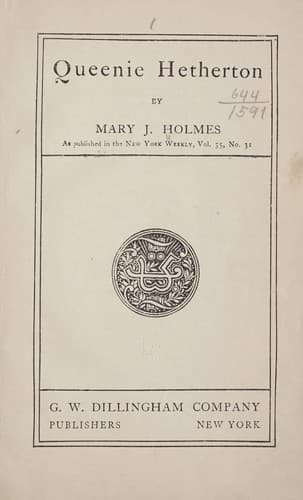
American fiction -- 19th century; Dime novels; Man-woman relationships -- Fiction; Upper class -- Fiction
But now that Phil was dead—Phil, who had been so much to him—Phil, whom
he loved far better than the cold, unsympathetic elder brother who had
died years ago, he felt a bitter sense of loss, and pain, and
loneliness, and as he rode slowly home in the gathering twilight of that
wintry afternoon, and thought of that bright young life and active mind
so suddenly blotted out of existence, if his theory was true, he
suddenly cried aloud:
“It cannot be; Phil is not gone from me forever. Somewhere we must meet
again. Death could only stupefy, not quench, all that vitality. There is
something beyond; there is a rallying point, a world where we shall meet
those whom we have loved and lost. And Phil is there, and some day I
shall find him. Thank God for that hope—thank God there is a hereafter.”
CHAPTER XXXVIII.
MOURNING FOR PHIL.
It was very bitter and deep, and all the more so because the blow had
fallen so suddenly, without a note of warning. At the Knoll there was a
small and select dinner party the evening the letter came. Some friends
from Boston were visiting in the house, and Mrs. Rossiter had invited a
few of the villagers to meet them, and in her evening dress of claret
velvet, with diamonds in her ears and at her throat, she looked as
lovely and almost as young as in her early girlhood when she won the
heart of the grave and silent Paul Rossiter. Dinner had been over some
little time, and she was standing with her guests in the drawing-room
when the fatal letter was brought to her. She saw it was from Madras,
and that the handwriting was a stranger’s; and though it was directed to
her husband, who immediately after dinner had wandered off to his
conservatories, where he spent most of his time, she opened it
unhesitatingly, feeling sure that it contained tidings of her son, and
feeling, too, with that subtle intuition which so often precedes
dreadful news, that the tidings were not good. But she was not prepared
to hear that Phil was dead; and when she read that he would never return
to her again, she gave one long, agonizing shriek, and dropped upon the
floor in a faint so nearly resembling death that for a little while they
feared she was really dead. Fortunately the family physician was among
the guests, and so relief was immediate, or she might never have
returned to consciousness, so terrible was the shock to her nervous
system. For hours she passed from one fainting fit into another, and
when these were over lay in a kind of semi-stupor, moaning at intervals:
“Oh, my boy! my Phil, my darling—dead—gone from me forever—my boy, my
boy!”
Public-domain text, read in full here on John Shaqi.
Reviews
Reviews
No reviews yet
Be the first to share your thoughts on this work.
Elsewhere in the archive
Join the Discussion
Join the discussion
Sign in to leave a comment or review.
Sign InorCreate an account