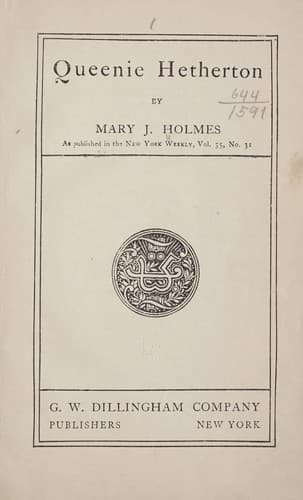
American fiction -- 19th century; Dime novels; Man-woman relationships -- Fiction; Upper class -- Fiction
Then Paul Rossiter broke down and cried as few men ever cry, and sobbed
till it seemed as if his heart would break, while his wife, now the
stronger and calmer of the two, supported him, and tried to comfort him.
There was perfect accord and confidence between the husband and wife
after that, and Mrs. Rossiter roused herself to something like
cheerfulness and interest in the world about her for the sake of the man
who, except to her, never mentioned Philip’s name, but who grew old and
gray and bent so fast and sometimes even forgot to water his ferns and
let them dry and wither in their pots, where they might have died but
for his wife, who took charge of them herself, and gave them the care
they needed.
Like their father, Ethel and Grace were very quiet in their grief, which
was not the less acute for that. A thought of Phil was always in their
hearts, though they never spoke of him voluntarily, and always changed
the conversation as soon as possible when his name was mentioned. But
oh, how they missed him everywhere: missed his quick, springing step
upon the walk as he came in, bright, and fresh, and gay, from doing
nothing—his cheery whistle, or snatches of song, or his playful
badinage, and all the thousand little acts by which a good, kind brother
can make himself beloved. If they could have seen him dead—if his body
could have been brought home and buried in quiet Merrivale, under the
shadows of the pines, where they could have kept his grave bright with
flowers and watered it with their tears—it would have been some solace
for their pain. But alas! he had no grave, no resting-place, save those
deep, dark Eastern waters, and who could tell what horrid monster of the
deep might have torn and mangled his manly form ere it reached the
bottom of the sea! It was too horrible to think of; and the faces of his
mother and sisters grew whiter and thinner each day, for each day they
missed more and more the young man who had been the sunlight of their
home.
Poor Grandma Ferguson, too, was completely prostrated at first with the
suddenness of the blow, and could only sit and cry like a little child
for the boy whom she had loved so dearly, and who had always been kind
and affectionate to her.
“No matter if I ain’t nothin’ but a homespun, uneddicated critter; he
never acted an atom ashamed of me, and when he had some high young city
bucks visitin’ him he allus brought ’em to see me and get some of my
strawberry short-cake or mince pies,” she said to a neighbor who was
trying to comfort her. “He never sassed me but once, and then he was a
boy, and didn’t know no better, and he was sorry, too,” she said; and
she went on to relate the circumstances of his coming to her the night
before he went away to school, and asking her forgiveness for the rude
words he had said to her, when she kissed him and called him her baby.
Public-domain text, read in full here on John Shaqi.
Reviews
Reviews
No reviews yet
Be the first to share your thoughts on this work.
Elsewhere in the archive
Join the Discussion
Join the discussion
Sign in to leave a comment or review.
Sign InorCreate an account