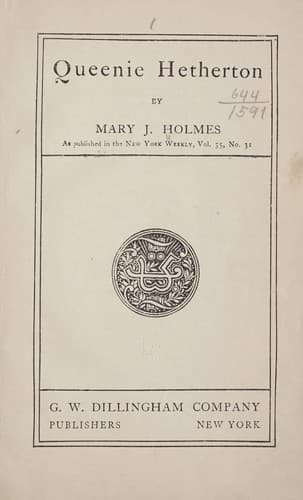
American fiction -- 19th century; Dime novels; Man-woman relationships -- Fiction; Upper class -- Fiction
And still she read on, taking next the second letter, the one which had
contained the lock of hair, and which was written two or three months
after the first. Evidently Mr. Hetherton had been in Marseilles and seen
the writer, for she spoke of his recent visit and the great pleasure it
had given her. It was in this letter that she called herself _his little
Tina_, and had written: “I have been sick most of the time since you
were here, and that is why I did not answer your letter at once. You
were so kind to me and treated me with so much tenderness that I cannot
help believing you mean to make me your wife before the world just as
you said you made me your wife before Heaven. But why put it off any
longer? Can you not bring a clergyman here, and not wait till people
call me a bad woman, which God knows I never meant to be. Oh, if you
would take me to Chateau des Fleurs as your wife. I would be your very
slave and make up to you in love and fidelity what I lack in culture.
You say I am very pretty. You praised my eyes and hair when you were
here, and so I send you a lock of the latter, and hope it will sometimes
remind you of your little Tina.”
“That’s the tress I burned,” Queenie whispered, feeling as if she, too,
were burning and writhing on live coals just as the lock of blue-black
hair had writhed and hissed in the flame.
But there was still another letter, and she read it, while every hair of
her head seemed to stand on end, and instead of burning with heat she
shook with cold, as she devoured the contents, which threw such a flood
of light upon what had gone before, and which she had not suspected. She
had read enough to make her hate Christine, and almost hate her father,
who, she felt, was most to blame, but she had no suspicion of the real
state of things until she began to read the third letter, which showed
great physical weakness on the part of the writer.
“Dear Mr. Hetherton,” it began, “I have been so sick that the old woman
who attends me thought I should die, but I am better now, though still
so weak as scarcely to be able to hold my pen. But I must tell you of my
dear little girl who was born two weeks ago, and who now lies sleeping
at my side.”
“_What!_” Reinette exclaimed, aloud, clasping both hands to her forehead
as if a heavy blow had fallen there. “What does she say? A little girl
born in Marseilles—that was—_Margery_.”
She could scarcely articulate the last word, for her tongue was thick
and parched, and in her ears was a sound like the roar of the wind
outside.
Public-domain text, read in full here on John Shaqi.
Reviews
Reviews
No reviews yet
Be the first to share your thoughts on this work.
Elsewhere in the archive
Join the Discussion
Join the discussion
Sign in to leave a comment or review.
Sign InorCreate an account