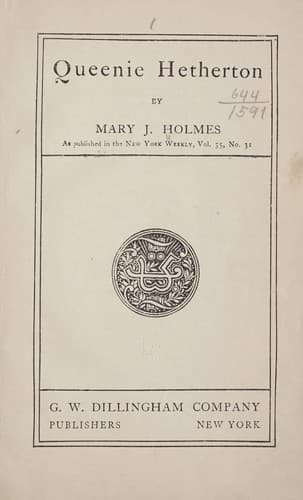
American fiction -- 19th century; Dime novels; Man-woman relationships -- Fiction; Upper class -- Fiction
“Oh, oh!” she cried, throwing up her hands as if in quest of some
support; then they dropped helplessly at her side, and she fell forward
upon her face, with the blood gushing from her nose and staining her
dressing-gown. How long she lay thus, she did not know, for since the
clock struck three she had taken no note of time, but when she came to
herself the cold gray of the early dawn was stealing into the room, and
far away in the vicinity of the kitchen she heard the sound of some one
stirring. The fire was out, and the candle was out, and she was cold,
and stiff, and bewildered, and could not at first remember what had
happened. But it came back to her with the rustling of the letter she
still held in her hand—came with a terrible pain, which made her cry out
faintly as she staggered to her feet, and lighted another candle, for
she had not finished the letter yet. But she finished it at last and
laid it with the others, while there swept over her a feeling of
delight, mingled with the horror she had at first experienced.
_Margery_ was that little girl born in Marseilles, and whom Christine
was sure Mr. Hetherton would love, because he was so fond of children.
“Yes, that was Margery,” she said, “and if so, she is my sister. Does
she know, I wonder? Did Christine tell her the day she was so suddenly
taken ill, and is that the reason she has seemed so different since?
seemed to shun me at times as if afraid of me? Yes, she knows, and I
shall tell her that I know, too, and that I love her better than ever.
She is not to blame. No one can censure her, or cast a slight upon her,
for she is _my sister_, and I shall proclaim her as such, and bring her
to live with me, and share my fortune with her, and make her take her
father’s name. But Christine must not stay. I could not endure to see
her every day, and be thus reminded of all I had lost in losing faith in
my father. Christine must go. She was false to _mother_, false to _me_;
and where was I when she was living in Marseilles? She could not have
cared for me long after mother died. I do not believe she ever took me
to Chateau des Fleurs, or ever was my nurse, as I have supposed. I have
wasted too much love on her, but I know her now, and shall deal with her
accordingly.”
Such, in substance, were Reinette’s thoughts as she sat shivering in the
cold, cheerless room, while the morning light crept in at the windows,
and she could see herself distinctly in the glass upon the mantel.
Public-domain text, read in full here on John Shaqi.
Reviews
Reviews
No reviews yet
Be the first to share your thoughts on this work.
Elsewhere in the archive
Join the Discussion
Join the discussion
Sign in to leave a comment or review.
Sign InorCreate an account