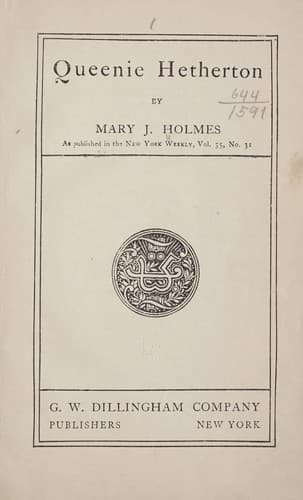
American fiction -- 19th century; Dime novels; Man-woman relationships -- Fiction; Upper class -- Fiction
“Excuse me, Margie, if I do not let you in. I am not quite dressed, but
shall come down very soon.”
She was very white when she did at last go down to the dining-room, and
Margery noticed it and said: “Are you sick this morning? You are as pale
as ashes, and there are dark circles around your eyes. Oh, Queenie, I am
so sorry for you;” and thinking only of Phil as the cause of Queenie’s
pale face and hollow eyes, Margery drew her head down upon her arm and
smoothed the shining hair caressingly.
Then Queenie came nearer crying that she had since she first heard Phil
was dead. Grasping Margery’s hand she sobbed hysterically for a moment,
though no tears came to cool her aching eyeballs.
“I must not give way,” she said, “for I have a great deal to do to-day.
Where is your mother, Margie? I must see her. Find her, please, and
bring her here; or no, we will go into the library. No one will disturb
us there, and we must be alone. Call your mother, Margie, I cannot
wait.”
What did it mean, and why was Queenie so strange this morning, like one
unsettled in her mind? Margie asked herself, as she went in quest of her
mother, to whom she gave Queenie’s message.
“What can she want with me, I wonder?” Mrs. La Rue thought, as she went
to the library, where she found Reinette curled up in a large
easy-chair, which she did no more than half fill.
Her head was leaning against the cushioned back, and her face looked
very white and wan, while her eyes wore a peculiar expression as they
fixed themselves on Mrs. La Rue. It was the same chair and the same
position Queenie had occupied on the occasion of her first interview
with Phil, who had stood leaning his elbow upon the mantel while he
looked at her curiously. Something brought that day back to Queenie’s
mind, and a sob which was more for the dead Phil than for the secret she
held escaped her as she bade good-morning to Mrs. La Rue, who said:
“What is it, _Petite_?”
This was the name Mrs. La Rue had often applied to her during the last
few days, and Queenie had liked it heretofore, but now she shuddered and
shrank away, and when Mrs. La Rue laid her hand upon her head and asked
if it ached, she cried out:
“Don’t touch me, or come near me. I don’t know whether my head aches or
not. But my heart is aching with a pang to which physical pain is
nothing. Christine, I have lost all faith in you—faith in father—faith
in everything. I know the whole now—_you_ are _Tina_, the shame-faced,
who wrote those letters to my father and sent him a lock of your hair!”
CHAPTER XLI
QUEENIE LEARNS THE TRUTH.
Public-domain text, read in full here on John Shaqi.
Reviews
Reviews
No reviews yet
Be the first to share your thoughts on this work.
Elsewhere in the archive
Join the Discussion
Join the discussion
Sign in to leave a comment or review.
Sign InorCreate an account