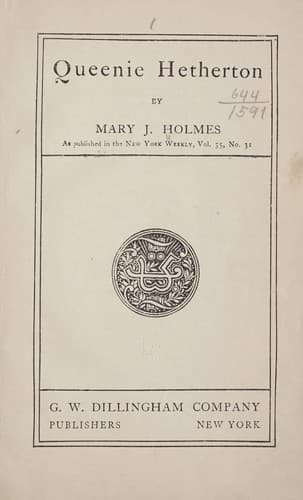
American fiction -- 19th century; Dime novels; Man-woman relationships -- Fiction; Upper class -- Fiction
It was a very white, haggard face which looked at her from the mirror,
and the eyes almost frightened her with their expression. About her
mouth and on the front of her dress were spots of blood which had
dropped from her nose while she was unconscious, and which added to her
unnatural appearance. The stains upon her face she washed away; and
exchanging her dressing-gown for a fresh one, crept into bed, for she
was very cold and dizzy and faint, while, in spite of the wild
excitement under which she was laboring, there was stealing over her a
heavy stupor which she could not throw off, and when at the usual hour
Pierre came to make her fire, he found her sleeping so soundly that he
went softly out and left her alone. An hour later, Margery looked in,
but Queenie was still asleep, nor did she waken when, as cautiously as
possible, a fire was kindled in the grate to make the room more
comfortable, for the morning was bitterly cold, and the frost lay
thickly upon the windows. Margery could not see Queenie’s face, as it
was turned toward the wall, and so she had no suspicion of the frightful
storm which had swept over the young girl during the night. The letters
still lay upon the table, and Margery saw them there, but did not touch
them or dream what they contained, and after putting the room a little
to rights she went quietly out, leaving her friend to sleep until the
clock struck ten. Then, with a start, Queenie awoke, and opening her
eyes, looked about her with that vague sense of misery and pain we have
all felt at some period of our lives, when the first thought on waking
was, “Why is it I feel so badly?”
To Queenie it came very soon why she felt so badly, and with a moan she
hid her face in her pillow, while something like a cry escaped her as
she whispered:
“I thought him so good and true, and now I know him to have been so bad.
He was false to mother, false to Christine, and doubly false to Margery,
whom he repudiated and disowned. Why did he not bring her home like a
man when I first told him of her? Why did he not say to me, ‘Queenie, I
have done a great wrong which many people in this country think of no
consequence, but which, nevertheless, is a sin, for which I am sorry and
would make amends. Little Margery La Rue is your sister, and I wish to
bring her home to live with you and share equally with you as if no
cloud hung over her birth. Will you let her come, Queenie?’ Oh, if he
had done this I should have taken her so gladly, and been spared all
this pain. Oh, father, father, you have dealt most cruelly with both
your children, Margery and me!”
Queenie had risen by this time and was making her toilet, for she meant
to appear as natural as possible to Mrs. La Rue and Margery until the
moment came for her to speak and know every particular of her sister’s
birth. While she was dressing Margery came to the door, but it was
locked, and Queenie called to her:
Public-domain text, read in full here on John Shaqi.
Reviews
Reviews
No reviews yet
Be the first to share your thoughts on this work.
Elsewhere in the archive
Join the Discussion
Join the discussion
Sign in to leave a comment or review.
Sign InorCreate an account