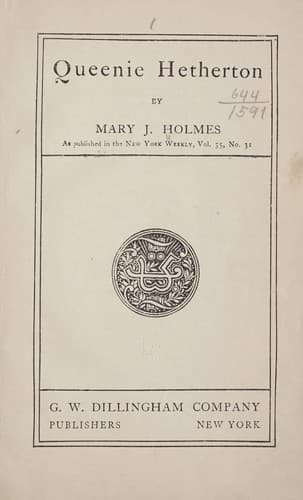
American fiction -- 19th century; Dime novels; Man-woman relationships -- Fiction; Upper class -- Fiction
“I see it all now, and understand his remorse on shipboard before he
died. He was thinking of the past, and his thoughts were like a
scorpion, stinging him to madness and making him long to confess to me
the wrong he had done. But he could not, weak as he was then and worn;
he could not tell me, when he knew how much I loved and honored him, but
he made me promise solemnly to forgive him if I ever found it out, and I
promised, and I’ll keep the promise, too, though just now, I feel hard
and bitter toward him, and were he living I should rebel against him so
hotly and say I never could forgive him, as I never can you, whom I
loved and respected, but whom I now know to be false in everything. You
have made me believe a lie, from first to last, until I can credit
nothing you have told me, and am ready to doubt if your name is really
La Rue, or if that man were your husband.”
“He _was_ my husband. I never deceived you there,” Christine exclaimed.
“But he was not Margery’s father,” Reinette continued, holding her
breath for the answer, which did not come at once.
While she had been talking so rapidly, Christine had stood rigid and
immovable, with a strange look upon her face and a gleam in her eyes
such as mad people sometimes wear when they are becoming dangerous.
Queenie’s sudden and unexpected attack had so confounded and bewildered
Christine that she felt her brain reeling, and was conscious of a
feeling as if she were losing control of herself and should not long be
responsible for what she said. When Queenie spoke of M. La Rue as one
who possibly was not her husband, she roused in her own defense and
answered; but at Queenie’s next question she hesitated, while the blood
came surging into her face, which was almost purple in spots, before she
replied.
“_No_, he was _not_ Margery’s father,” and the woman’s voice was hard
and pitiless, while the gleam in her eye was wilder and more like a
maniac as she went on:
“Queenie Hetherton, if you drive me too far I may say what I shall be
sorry for and what you will be sorry to hear. The worm will turn when
trodden upon, and a miserable wretch like me will not be pressed too
sorely without trying to defend herself. I am wicked and sinful, it is
true; but in one sense I was not false to Mrs. Hetherton, and God knows
what I have suffered—knows of the years of anguish and remorse when I
would have so gladly undone the past if I could; but it was too late.
You have found those letters, it seems. Your father was foolish to keep
them; he ought to have burned them, as I did his; but—but—the fact that
he did not tells me he cared more for me than I supposed—that in his
proud heart there was something which bound him to me lowly born as I
am,” and over Christine’s face as she said this there came a smile of
pleasure and gratification in the thought that Frederick Hetherton had
kept her letters, even though they had failed to produce any result.
Public-domain text, read in full here on John Shaqi.
Reviews
Reviews
No reviews yet
Be the first to share your thoughts on this work.
Elsewhere in the archive
Join the Discussion
Join the discussion
Sign in to leave a comment or review.
Sign InorCreate an account