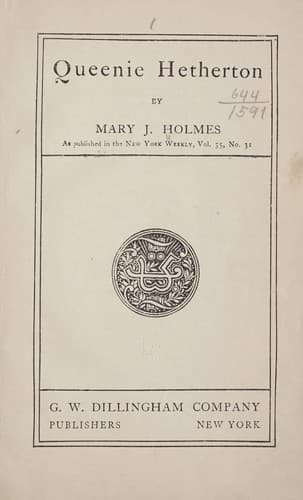
American fiction -- 19th century; Dime novels; Man-woman relationships -- Fiction; Upper class -- Fiction
The look made Queenie angrier than she had been before, for she
interpreted it aright, and her pride rose up against it.
“My father never cared for you,” she said. “It was only a fancy, which
would never have existed at all if you had not tried to attract him.”
“It is false!” Mrs. La Rue exclaimed, taking a step forward, with
flashing eyes, before which even Queenie quailed. “It is false. I did
_not_ try to attract him at first, but he noticed and talked to and
flattered me until my head he turned and I thought all things possible.
The wrong was on his side. I was not bad nor had a thought of badness in
my heart, and you, Queenie, of all others, should not speak to me as you
have done. Margery did not, and hers is the greater wrong.”
“Then you have told Margery!” Reinette exclaimed, and before Mrs. La Rue
could answer, Margery herself came to the door asking:
“Did you call me, Queenie? I thought I heard my name.”
“No, no,” Mrs. La Rue almost screamed, as she turned like a tigress upon
Margery. “Go away, I tell you, go away. I am losing my senses, and with
you both standing here, and Queenie talking to me as she has talked, I
shall tell what I have sworn not to tell. Go away, Margery—go!”
But Margery did not move except to advance a little farther into the
room, where she stood, with a blanched cheek and wondering, frightened
eyes, gazing first at her mother and then at Queenie, who stretched her
arms toward her and, with quivering lips and a voice full of unutterable
pathos and love, said:
“You are my _sister_. Come to me.”
But Margery did not move, and her face grew whiter and more death-like,
as she whispered to her mother:
“What does she mean? Have you told her? Does she know it all, and still
call me _sister_?”
“Hush, Margie. No, she does not know it all,” Mrs. La Rue replied; and,
sinking into a chair and bowing her head upon her hands, Margery
exclaimed:
“Thank God for that! Oh, Queenie, I don’t know what you know or how you
learned it; but if you love me, if you care for your own happiness, seek
to know no more. Let the matter end here. If you believe I am your
sister, love me as such; I shall be content with that.”
She did not look up, but sat with her head bowed down as if with grief
or shame. Queenie thought it the latter, and crossed the room to where
Margery sat, and, kneeling beside her, wound both arms around her neck
and said:
“Margie, I know you are my father’s child, and I love you so dearly that
this shall make no difference with me. You were not to blame, my
darling. You had no part in the wrong; it was my father, may God forgive
him, and this woman, who I am sorry to say is your mother, and whom I
cannot forgive.”
Public-domain text, read in full here on John Shaqi.
Reviews
Reviews
No reviews yet
Be the first to share your thoughts on this work.
Elsewhere in the archive
Join the Discussion
Join the discussion
Sign in to leave a comment or review.
Sign InorCreate an account