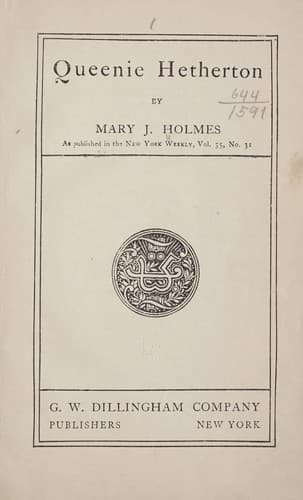
American fiction -- 19th century; Dime novels; Man-woman relationships -- Fiction; Upper class -- Fiction
Margery had released her hold of the woman’s arm and sank upon the
floor, where she sat with her knees drawn up, her arms encircling them,
her head resting upon them, and her whole body trembling as with an ague
chill. She had done all she could to avert the calamity. She had tried
to save Queenie from the blow which she knew would fall so crushingly,
and she had failed. Her mother was a maniac for the time being, and was
doing what she had sworn never to do. She was telling Queenie, and
Margery was powerless to prevent it.
“Margaret Ferguson’s daughter!” Queenie repeated in a whisper, which,
low as it was, sounded distinctly through the room, and told how the
young girl’s heart was wrung with a mortal fear as she continued: “then
who am I, and who are you?”
For a moment there was a death-like silence in the room, for Christine,
half crazed though she was, shrank from declaring what she knew would be
the bitterest dreg in all the bitter cup. How could she tell the truth
to that young girl who had been so proud of her blood and of her birth,
and who even in her pain, when every limb was quivering with nervous
dread and excitement, stood up so erect before her like one born to
command. But she must do it now; she had gone too far to recede—had told
too much not to tell the whole, and when Queenie asked again, “who am I,
and who are you?” she answered, “_I am your mother_;” but she said it
very softly and low, for her heart was full of a great pity for the
girl, over whose face there came that pallid, grayish look which comes
upon the face of the dying when the death pang is hard to bear, and who
writhed a moment in agony as the insect writhes when put upon the coals.
She was still looking fixedly at Christine, though she did not see her,
for there was a blackness before her wide-open, staring eyes, and in her
ears there was a sound like the roar of many waters, when the skies
overhead are angry and dark. For a second the scene around her had
vanished away. She did not see Margery upon the floor, with her arms
still encircling her knees and her head bowed upon them—did not see the
woman standing so near to her, and who had spoken those terrible words,
but strangely enough saw the far-off Indian sea and Phil’s white face as
it sank beneath the waves with a wild cry for her upon his lips.
Mechanically she put up her hand to brush that vision away, and then the
present came back to her with all its horror so much worse than the
death of Phil had been, and she remembered the words Christine had
spoken, “I am your mother!”
“My-my-my-m-mo-th-er,” she tried to say when she could speak, but the
words died away upon her white, quivering lips in a kind of babbling
sound, which was succeeded by a hysterical laugh so nearly resembling
imbecility that Margery looked up, and a cold shudder curdled her blood
as she saw the face from which all resemblance to Queenie had vanished,
and on which that ghastly, meaningless laugh was still visible.
Public-domain text, read in full here on John Shaqi.
Reviews
Reviews
No reviews yet
Be the first to share your thoughts on this work.
Elsewhere in the archive
Join the Discussion
Join the discussion
Sign in to leave a comment or review.
Sign InorCreate an account