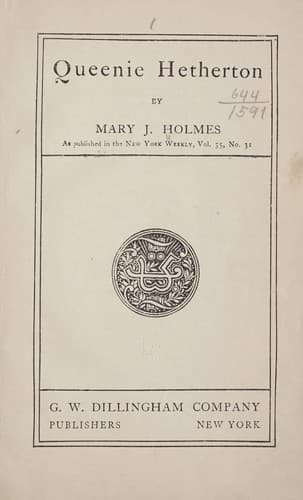
American fiction -- 19th century; Dime novels; Man-woman relationships -- Fiction; Upper class -- Fiction
Struggling to her feet she wound her arm around Queenie, saying to her
mother, as she did so:
“You have destroyed her intellect. You have made her an imbecile.”
But Margery was mistaken. Queenie’s mind was not destroyed, though for
many hours she remained in that condition, when her reason seemed to be
tottering and her white lips had no power to frame the words she wished
to say. They did not send for a physician, though it was Christine’s
wish to do so; but Margery said:
“No, we will not parade this secret before the world. I can bring her to
herself if any one can, and when I do I shall, if possible, persuade her
that it is all a delusion of her brain—that she did not hear aright. Oh,
why did you tell her? Why did you break your promise?”
“Because I was angry, was crazy, and did not know what I said,”
Christine replied. “Her manner toward me provoked me more than her
words, and roused in me a demon which would not be quieted, and so I
told her all; and I am glad, for now I carry no dreadful secret to make
my days so full of pain and my nights one long black horror. I have told
the truth, and can call her my daughter now—my child—for she is my own
flesh and blood—the little black-haired creature which lay in my arms
and flashed her bright eyes on me—on _me_—her mother.”
And as she said this, Mrs. La Rue’s face glowed with excitement and her
eyes shone with all the fire of her fresh girlhood when Frederick
Hetherton had told her she was pretty. Margery had been dear to her as
her own life, which she would at any time have given for the girl whom
she had so wronged: but with her confession there had swept over her a
great wave of motherly love and tenderness for the poor little girl who,
in her own room, whither Margery had taken her, sat in the great
easy-chair, motionless as a stone, with her hands lying helplessly upon
her lap, and her eyes, from which all the sparkle and brightness were
gone, looking always from the window across the snow-clad hills and
meadows to the spot where the tall evergreens marked the burial-place of
the dead. Sometimes Margery went and spoke to her. But Queenie did not
answer until late in the afternoon, when Margery came and stood between
her and the window. Then she said, entreatingly:
“Move away, please. I am looking over to where father lies, and thinking
of all he said to me before he died. Oh, Margie,” and the poor little
white face quivered and the voice was very sad and piteous, “Is a lie to
the dead worse than a lie to the living? I told him I would forgive him,
whatever it was, and I cannot, I cannot, and my heart is so bitter and
hard toward him and _her_, and all the world except _you_. Oh, Margie,
Margie, you will not turn against me? You will love me just a little, I
could not help it, and I love you so much. I would have stood by _you_
in the face of the whole world; stand by me, Margie, will you?”
Public-domain text, read in full here on John Shaqi.
Reviews
Reviews
No reviews yet
Be the first to share your thoughts on this work.
Elsewhere in the archive
Join the Discussion
Join the discussion
Sign in to leave a comment or review.
Sign InorCreate an account