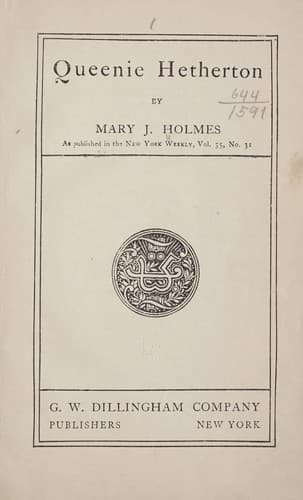
American fiction -- 19th century; Dime novels; Man-woman relationships -- Fiction; Upper class -- Fiction
Christine was quick to detect the change in Queenie’s voice and manner,
and her face was brighter as she replied: “After I left you I went to
Paris, to Florine’s apartments, where I found a healthy, beautiful
child, whom no one could see and not love. My heart was very sore and
full of a great longing for my own baby girl left at Chateau des Fleurs,
and when she toddled to my side and put up her sweet lips to be kissed,
as was a habit of hers, I took her in my arms and into my heart and made
a solemn vow to be true to her and never let her feel the want of a
mother’s love. I told her to call me mamma, and the name came prettily
from her lips. I was younger and better looking than Florine, and she
took to me readily, and slept in my arms and cried when I left her to
look for lodgings and employment. I found both: the first with a
hair-dresser in Rue de Richelieu, and the second on the upper floor of
number —— Rue St. Honore, where you came to us one day and changed
Margery’s whole life. Had I chosen to use the money your father paid me
annually, we might have lived in much better style, but I shrank from
touching more of it than it was absolutely necessary, and took pleasure
in supporting her by my own hard labor. I would lay the money by for her
until she married, if she ever did, or until she needed it more, I
thought; and should she marry now she would not go empty-handed to her
husband, for there are many thousand dollars invested for her in France.
“How I toiled and slaved for her, and how I loved her as time went on
and she grew more and more into my heart; loved her so much, in fact,
that your image gradually began to fade, and I could think of you
without a pang. I saw you occasionally—once in the grounds at the
Chateau, where I came upon you with your nurse, and several times in the
streets of Paris, after your father brought you there. I used to take
Margery out upon the Champs d’Elysees on fine afternoons when the
streets were full of people driving out to the Bois, and hiring a chair
I would hold her in my lap and watch for your father to pass. Though not
the most showy—for his taste was too good for that—Mr. Hetherton’s
turn-out was the most elegant and probably the most expensive of all the
private carriages in Paris, while his splendid thoroughbreds were the
talk of the city. I always watched anxiously for him, and when he
appeared, sitting up so proud and erect, with that look of haughty
indifference and selfishness on his face, and with you beside him on the
cushions, clad in dainty apparel, I used to hold little Margery tightly
to my heart and bite my lips till the blood almost forced itself through
the skin, so fearful was I lest I should shriek out the truth so loudly
that he would hear it above the roll of the wheels and the tramp of the
horses’ hoofs. Something impelled me strongly to hold you high in my
arms, and, making him see you, say to him: ‘This is your lawful
daughter, the child of your wife who died in Rome.
Public-domain text, read in full here on John Shaqi.
Reviews
Reviews
No reviews yet
Be the first to share your thoughts on this work.
Elsewhere in the archive
Join the Discussion
Join the discussion
Sign in to leave a comment or review.
Sign InorCreate an account