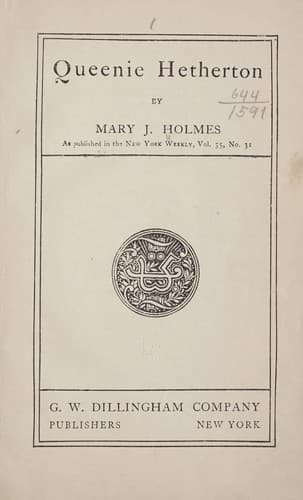
American fiction -- 19th century; Dime novels; Man-woman relationships -- Fiction; Upper class -- Fiction
“Queenie, you do wrong to talk as if anything for which you are not
responsible can make a difference with your friends—with me, who once
hoped to be more than your friend. Queenie, I asked you once to be my
wife, when you stood upon a dizzy height of prosperity and now I ask you
again when misfortune seems to be overtaking you. Will you be mine,
Queenie, and let me shield you from the storm and prove to you that I
have loved you for yourself rather than for your surroundings?”
Queenie’s face was a study, as she drew it away from his encircling
hands, and from sheer weakness and exhaustion lay wearily down upon the
pillows of the lounge while she looked at him long and earnestly. Never
before had Mr. Beresford seen so sweet, so soft and so womanly an
expression in the dark eyes as he saw there now, and never had she
seemed more desirable than she did when she answered him at last:
“I thank you so much, Mr. Beresford, for what you have said. It has done
me a great deal of good, for if you can like me for myself alone there
may be others who will do the same, and my life will not be quite so
dreary. I will do you the justice to say that I believe you are in
earnest now and mean what you say, but you are mistaken in the feeling
which prompts you. It is pity for me, not love. But I thank you just the
same, though I cannot accept your offer. When Phil went down beneath the
waves my heart went with him, never to return. And you, Mr. Beresford,
are destined for another. I know it; I have seen it, and am so glad. She
is worthy of you, and was worthy before accident revealed that in
everything she was your equal. And you will be so happy together
sometime when it is all settled, as it must be at once. Send for Mrs. La
Rue and hear her story; or rather, go to her. I could not listen to it
again. She will convince you of the truth of what she says, and you must
fix whatever there is to fix, so that Margery will have justice done her
as Mr. Hetherton’s daughter. Don’t let a thought of me interfere with
her rights. And now go to Mrs. La Rue.”
She waved him from her with her old air of authority and he had no
alternative but to obey, and wishing her good-morning he went below
stairs to seek an interview with Mrs. La Rue.
As they had no suspicion of what had happened, it was a mere accident
which sent the Rossiters to Hetherton Place that morning, and Mr.
Beresford found them in the library with Grandma Ferguson, who had told
them what she knew, and thrown them into a wild state of surprise and
excitement.
“Oh, Mr. Beresford,” Ethel said, going up to him as he entered the room,
“is it true that Reinette is not our cousin?”
“I do not know,” he replied; “I am going to question Mrs. La Rue. Shall
I have her in here and let you hear what she has to say?”
“Yes, let her come,” Mrs. Rossiter said; and in a few minutes Mrs. La
Rue entered the room, calmer and more collected than she had been in
months.
Public-domain text, read in full here on John Shaqi.
Reviews
Reviews
No reviews yet
Be the first to share your thoughts on this work.
Elsewhere in the archive
Join the Discussion
Join the discussion
Sign in to leave a comment or review.
Sign InorCreate an account