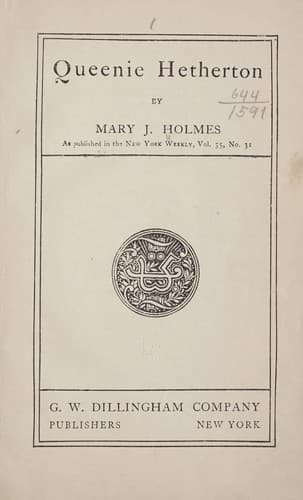
American fiction -- 19th century; Dime novels; Man-woman relationships -- Fiction; Upper class -- Fiction
She had told the truth to Queenie. The worst was over. She could meet
anything now; and at Mr. Beresford’s request she began her story, which
she repeated in a straightforward manner, never once crossing herself or
hesitating in the least, except when some strong emotion overcame her as
she spoke of Margery and the day Queenie came to her in the Rue St.
Honore. No one could doubt that she was telling the truth, and Mr.
Beresford did not doubt her, but he said to her when she had finished:
“Have you no other proof than your mere assertion of facts?”
“Yes,” she replied; “I can give you the name of the pension in Rome
where Mrs. Hetherton died, and of the physician who attended her, and
the clergyman who buried her. These gentlemen, if living, will testify
to the fact that she left an infant daughter, whom I took away with me.
Then, old Florine is still alive in Paris, and will show that I brought
Margery to her and took her away at such a date, while Jacques Berdotte
and his wife Jeanne, in Marseilles, can tell you that they served me
when Queenie was born; and I doubt not they will remember the American
gentleman who came to see me, and to whom I went when I left their
house. I think they are both alive. You can write and see. I have also
Mr. Hetherton’s last letter, written me from Paris when I was in the
south of France, and he had heard that the girl Margery, in whom Queenie
was so much interested, was my daughter. That will prove that Queenie is
my child; and after that you surely will believe me without the letter
which my mistress wrote to her husband not long before she died, and in
which she speaks of her blue-eyed, golden-haired baby, whom she hopes he
will love because it is so much like her. I did not destroy that letter,
though tempted to do so many times.”
She talked rapidly, and every word carried fresh conviction to Mrs.
Rossiter, who was eager to see Margery and claim her as her sister’s
child. Of the meeting between Margery and her newly-found friends it is
not my purpose to speak, except to say that at its close there was not
in the minds of either a shadow of doubt as to the tie between them.
But amid their joy there was a keen pang of regret and pain for the
little, desolate girl up stairs, who, when at last they went to her,
received them at first with a calm, stony face and dry eyes, which
seemed to flash defiance at any pity they might feel for her, but who
finally broke down in a storm of sobs and tears, and, laying her head on
Mrs. Rossiter’s lap, begged her not to despise her for what she could
not help.
“If I could die, I would,” she said, “but I cannot. I am young, and life
seems so lonely to me now, when once the days were too short for all I
had to enjoy. Oh, why has God so dealt with me?”
Public-domain text, read in full here on John Shaqi.
Reviews
Reviews
No reviews yet
Be the first to share your thoughts on this work.
Elsewhere in the archive
Join the Discussion
Join the discussion
Sign in to leave a comment or review.
Sign InorCreate an account