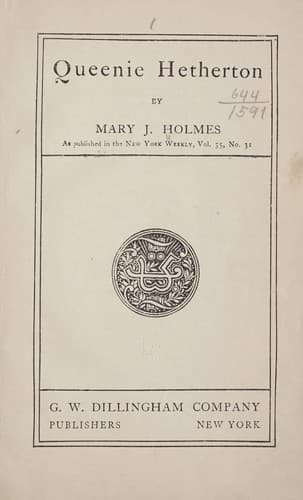
American fiction -- 19th century; Dime novels; Man-woman relationships -- Fiction; Upper class -- Fiction
Greatly refreshed with her night’s rest Queenie felt better and decided
that the place was not so bad, after all; but a close inspection of the
premises after breakfast convinced her that, for the present at least,
she must seek quarters elsewhere. Rooms there were in abundance, and
furniture, but everything had gone to decay; everything was moldy and
worm-eaten, and smelled of rats, and must and foul air. And still, as
Axie said, there were great capabilities in the place, and with a little
time and money, and a great deal of hard work, a portion of the house
could be made not only habitable, but very comfortable and attractive.
Meantime, Queenie must go away, for it was impossible for her to stay
there while the renovating process was going on. But where to go was a
question which troubled Queenie not a little, until Aunt Judy suggested
an idea to her by saying, “Thar’s Jacksonville on de river. Why not go
thar a spell? Heaps of de gentry from de Noff is thar, and a sight of
mighty fine dresses at dem grand hotels. Jacksonville is a mighty big
city—bigger dan New York, I reckon.”
Queenie had heard of Jacksonville, and she at once seized upon Judy’s
suggestion as something practicable. She would go to that winter
Saratoga of the South and see what it was like. Possibly she might be
amused with what she saw, and so the pain at her heart be lessened a
little. She would go that very day, she said, for she was full of a
burning restlessness and desire for change. But Judy, who knew something
of the running of the trains, told her it was then too late; she must
wait until the next day, and pass another night upon the kitchen table.
From this, however Queenie was saved, for, while they were speaking,
they caught the sound of wheels, and, shading her eyes with her hands,
Aunt Judy saw entering the park a carriage with a lady in it. “Dar’s
Miss Strong from de Homestead,” she exclaimed. “She’s de ole Govenor’s
darter and de fustest lady in dese parts. Got a head full of brains, and
writes for all de papers in de land. She be comen here, sho’-nuf.” And
Judy was right, for Boston had stopped at the Homestead the previous
night, and had told of the young lady—Miss Hetherton—whom he had brought
to Magnolia Park. Mrs. Strong remembered well the tall, handsome boy,
Frederick Hetherton, who, when she was a child, had passed a winter at
the Park, which was then one of the finest places in the State. She
remembered, too, the stately lady, his mother, who had more than once
dined at the Homestead, and she had no doubt that the young girl of whom
Boston told her, was the granddaughter of that lady, and daughter of the
boy Frederick. But why had she come to Magnolia Park so late in the
season, and how was she to exist, even for a day, in that dilapidated,
forsaken spot?
“I will go to see her at once and bring her home with me,” was Mrs.
Strong’s first thought, upon which she acted immediately.
Public-domain text, read in full here on John Shaqi.
Reviews
Reviews
No reviews yet
Be the first to share your thoughts on this work.
Elsewhere in the archive
Join the Discussion
Join the discussion
Sign in to leave a comment or review.
Sign InorCreate an account