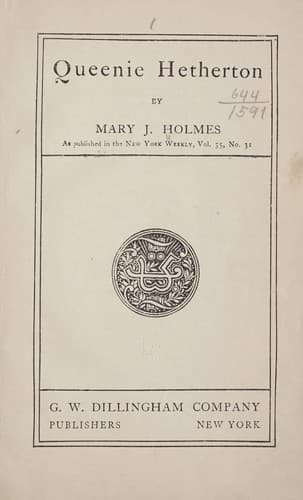
American fiction -- 19th century; Dime novels; Man-woman relationships -- Fiction; Upper class -- Fiction
Introducing herself to Queenie, who advanced to meet her as she
descended from her carriage, she said:
“If I mistake not, you are the daughter of Frederick Hetherton, whom I
knew when I was a little girl. Though several years older than myself,
he was very kind to me, and I have spent hours with him under the shadow
of these trees and those in the grounds of my own home.”
The mention of her father by one who had seen and known him brought the
hot tears at once to Queenie’s eyes, but she dashed them aside, and
explaining that Frederick Hetherton was her father, she led Mrs. Strong
into the house, and sitting down beside her, answered as well as she
could the questions which her visitor put to her concerning her home in
Paris and her father’s sad death on shipboard.
“I had heard something of this before,” Mrs. Strong said to her, “for
the lawyer who has charge of your father’s affairs at the North wrote to
a friend of mine who is supposed to look after the estate, that it now
belonged to a young lady, the only direct heir of the Hethertons. It is
rather a sorry place for a young girl to come to, but I suppose you do
not intend remaining here long.”
“Yes; always; I have no other home,” Queenie replied, and her voice was
choked with tears which she fought bravely back.
Mrs. Strong was a kind-hearted, far-seeing woman, and as she studied
this girl, scarcely older than her own daughter Nina, whom she somewhat
resembled, she felt strangely drawn toward her, and felt, too, that over
her young life some terrible storm had swept.
“I will not ask her what it is,” she thought, “but I’ll be a friend to
her, as I should wish some woman to befriend my Nina were she here alone
with those strange attendants.”
Then she said:
“I think I heard that Mr. Hetherton’s wife died in Rome, years ago. It
must have been at your birth.”
For a moment Queenie sat as rigid as if turned into stone, her fists
clinched, and her eyes staring at Mrs. Strong, who looked at her
wonderingly. Then a tremor ran through her frame, and she shook from
head to foot.
“Oh, I can’t bear it! I can’t bear it!” she cried, at last. “My head
will burst if I keep it. I must tell you the truth; you seem so good and
kind, and I want a friend so much. Mother did not die in Rome—that was
Margery’s mother; mine is still alive, and I had no right to be born.”
Then, amid bursts of tears and broken sobs, Queenie told her story from
beginning to end—from Chateau des Fleurs down to Magnolia Park, where
she had come to hide from all who had ever known her. Had Queenie tried,
she could not have found a more sympathizing listener to her recital,
and when it was finished, Mrs. Strong’s tears flowed almost as freely as
her own, as she took the young girl in her arms, and kissing her
lovingly, tried to comfort and reassure her, while at the same time she
administered a little reproof.
Public-domain text, read in full here on John Shaqi.
Reviews
Reviews
No reviews yet
Be the first to share your thoughts on this work.
Elsewhere in the archive
Join the Discussion
Join the discussion
Sign in to leave a comment or review.
Sign InorCreate an account