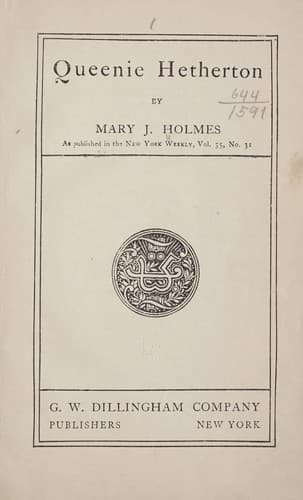
American fiction -- 19th century; Dime novels; Man-woman relationships -- Fiction; Upper class -- Fiction
So Anna’s star began to wane almost before it had risen, or would have
done so but for her perseverance and push, which oftentimes compelled
attention where it might not otherwise have been given. She was pretty,
and fast, and rich, and this gained her favor with a certain class, and
especially with the young men, with whom she was very popular. Night
after night, while her husband played at whist or euchre in the
gentlemen’s room, she danced and flirted in the parlors, and wore her
handsome dresses and diamonds, and furnished the _cats_ with no end of
gossip, and flattered herself that at last she was happy. With a woman’s
ready wit she soon discovered that she had made a mistake with regard to
Queenie, and so she changed her tactics and tried to be very gracious to
her, but Queenie did not need her patronage. She had scores of friends,
and the days passed pleasantly and rapidly away. Axie had returned to
the Park soon after Anna’s arrival, and wrote her mistress at last that
the house would be ready for her within a week, and at the end of that
time Queenie left the Hotel with Pierre, and went to begin a new life in
a home as unlike everything she had ever known as it well could be.
CHAPTER XLVII.
THE YELLOW FEVER.
It was very hot in Florida that summer, but it suited Queenie, who, like
some tropical plant, seemed to thrive under the burning sun which
affected even the negroes, accustomed to it as they were. Physically she
had never been better than she was at Magnolia Park, or prettier either,
for the bright color had crept back to her cheeks and her eyes had in
them a look of softness and humility, while the expression of her face
was ineffably sweet and gentle like the faces of some of the Madonnas.
She had suffered terribly, and the fierce storm through which she had
passed had left its marks upon her so that she would never again be
quite the same dashing, impetuous girl she once had been. Margery wrote
to her often,—long letters full of tenderness and affection, and
entreaties for her to return to the home which was not the same without
her.
From Grace and Ethel Rossiter she also heard frequently, and their
letters touched her closely, as they always addressed her as their
cousin, ignoring altogether the terrible thing which had separated her
from them. Once in speaking of Margery Ethel said: “She is very lonely
at Hetherton Place, though we go there often, and Mr. Beresford, we
hear, is there every day.”
Public-domain text, read in full here on John Shaqi.
Reviews
Reviews
No reviews yet
Be the first to share your thoughts on this work.
Elsewhere in the archive
Join the Discussion
Join the discussion
Sign in to leave a comment or review.
Sign InorCreate an account