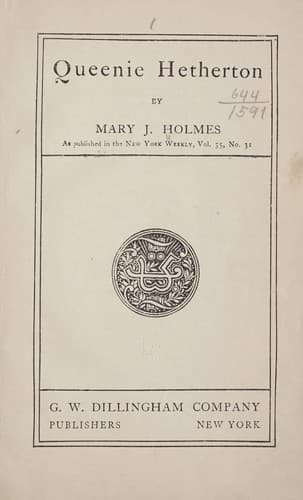
American fiction -- 19th century; Dime novels; Man-woman relationships -- Fiction; Upper class -- Fiction
This was underscored, and conveyed to Queenie’s mind just the meaning
Ethel meant it to convey. Mr. Beresford was daily growing more and more
interested in Margery, and Queenie rejoiced that it was so. She was so
glad for Margery to be happy in a good man’s love, though her own sun
had set in deepest gloom, and there was a ceaseless moan in her heart
for poor Phil, while the load of humiliation which had come so suddenly
upon her seemed sometimes greater than she could bear.
“If I only had something to do which would make me forget myself a
little I should be happier,” she thought, as morning after morning she
awoke to the same monotonous round of duties, or, rather, occupation of
trying to kill the time.
She had no real duties, for everything pertaining to the household
arrangements was managed by Aunt Judy, who petted her young mistress as
if she had been a queen, while both Pierre and Axie, watched vigilantly
to anticipate every want before it was framed in words.
Mrs. Strong was absent on her plantation near Lake Jackson, and thus
Queenie was left almost entirely alone and free to let her morbid
fancies feed upon themselves. She _did_ need something to do, and at
last the something came, though in a very different form from what she
would have chosen had it been hers to choose.
As the summer advanced it grew hotter and hotter until the nights were
like the days, and there came no breath of air to relieve the dreadful
heat. There were rumors of sunstroke here and there, and talk of the
sickness which must ensue if the state of things continued. And still in
middle Florida it was comparatively healthy, and the air was free from
malaria; but farther to the north, where a city spread itself over miles
of territory, an ominous cloud was gathering. Once before the town had
been scourged as with the plague, and the terror-stricken inhabitants
had fled to the country for refuge from the pestilence, which oftentimes
overtook them on the road and claimed them for its victims. And now it
was coming again—was lurking in the corners of the lanes and alleys,
where poverty and filth held high carnival—was breathed in the poisonous
air which brooded over the doomed city like a pall, until at last it was
_there_, and men spoke the awful word to each other in whispers, while
their voices shook with fear and their hearts sank as they remembered
the past and thought of the possible future. The _yellow fever_ was in
their midst, and though as yet confined to the poorer classes and the
unfrequented parts of the city, the people knew too well that, like fire
applied to cotton, it would spread until there was no house however
grand, or spot however exclusive, which its shadow would not reach, its
horrid presence threaten. The city was doomed, and as the days went by
and the disease and danger grew, and the death roll increased, and men
who walked the streets to-day were dead to-morrow, a panic seized upon
Public-domain text, read in full here on John Shaqi.
Reviews
Reviews
No reviews yet
Be the first to share your thoughts on this work.
Elsewhere in the archive
Join the Discussion
Join the discussion
Sign in to leave a comment or review.
Sign InorCreate an account