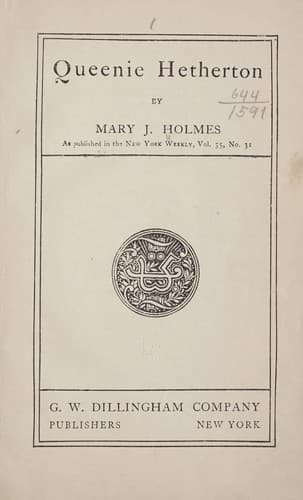
American fiction -- 19th century; Dime novels; Man-woman relationships -- Fiction; Upper class -- Fiction
the terror-stricken inhabitants, who fled before the horror as those who
live on a frontier in time of war flee from the rapidly advancing enemy.
Then it was, when the city was almost deserted, that the cry went up for
help for the sick and the dying. And the North heard that cry as well as
the South, and poured out her treasures with a most liberal hand, and
“help for Memphis” was the watchword everywhere. Physicians were wanted,
with nurses for the sick and deserted ones, and this demand it was which
tried to the very quick the courage of those on whom it was made.
It was an easy matter to give of one’s substance to the needy, to drop
the money into the boxes placed everywhere for that purpose, but to take
one’s life in his hands and go into the very jaws of death, where the
air was full of infection and the very flowers seemed to exhale a deadly
poison, was a different thing. But there were hundreds of brave men and
women who, from the New England hills, and the prairies of the West, and
the pine glades of the South, went to the rescue, and by their noble
heroism proved themselves more Christ-like than human. In her far-off
Florida home Queenie heard the cry for help, and to herself she said:
“Here is something for me to do. Here is my chance, and I’ll take it.”
Had she known just what yellow fever was, she might have hesitated ere
she made her decision, or having made it, might have drawn back from it
at the frantic entreaties of Pierre, who, when she communicated her
intention to him, fell upon his knees and with blanched face and
chattering teeth begged her not to go where there was certain death for
them both, for his place was with her: if she went, he must go also.
Axie, too, tried to dissuade her from her purpose, but Queenie would not
listen.
“I am not afraid,” she said. “I shall not take the fever. I never catch
things as some people do. I sat three hours once with a servant who had
the small-pox, and who died two hours after, and I did not take it.
Somebody must go, and I have nobody to care much if I should die. Nobody
but Margery, and she would say I was doing right. So pack my trunk, like
a good, brave girl, for I must be off to-morrow. Something which I
cannot resist is calling me to Memphis. What it is I cannot tell, but I
must go.”
And so the next night the northern train for Savannah took in it Pierre
and Queenie, bound for the fever-smitten city where the people were
dying so fast and help was sorely needed. By some strange coincidence
while Queenie was making up her mind to _go_ to Memphis, Christine La
Rue was already there. She, too, had heard the cry for help, and it
roused her from the state bordering on insanity into which she was
falling.
Public-domain text, read in full here on John Shaqi.
Reviews
Reviews
No reviews yet
Be the first to share your thoughts on this work.
Elsewhere in the archive
Join the Discussion
Join the discussion
Sign in to leave a comment or review.
Sign InorCreate an account