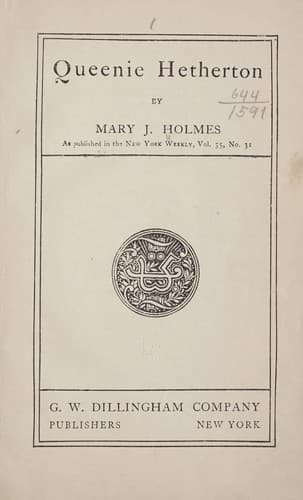
American fiction -- 19th century; Dime novels; Man-woman relationships -- Fiction; Upper class -- Fiction
There were bright red spots upon her cheeks, but the lips which touched
Queenie were cold as ice, as was the hand which accidentally brushed
Queenie’s cheek. Ordinarily Queenie would have resented this liberty,
but she did not now. She was too much excited to resent any thing, and
she was so glad afterward that it was so—glad that she had some thought
and care for Christine, to whom she said, as she felt her lips and hand:
“How cold you are, and why do you tremble so? You surely must be ill.
Don’t go out to-night; there must be plenty of vacant rooms here. Stay
and rest yourself. We cannot let you die.”
She had one of Christine’s cold hands in her own, chafing and rubbing it
as she spoke, but when she said, so kindly, “We cannot let you die,” the
woman drew it away suddenly, and bursting into a paroxysm of tears,
exclaimed:
“Better so; better for me to die; but for you, oh! Queenie, you must
live—you and——Oh, my child, summon all your strength and courage; you
will need it. There is hard work ahead for you. Do you think you can
meet it?”
Queenie did not know what the woman meant, but she was greatly moved and
agitated, and shook from head to foot with a nameless terror.
“You, too, are cold are trembling, and that will never do. Drink this,”
Christine said, pouring from a flask which she always carried with her a
quantity of brandy, and offering it to Queenie, who swallowed it in one
draught.
The brandy steadied her nerves, and after standing a moment watching
Christine as she went slowly down the stairs, holding to the banisters,
like one suffering from great physical weakness, she turned toward the
door of the sick-room, and opening it softly, went in.
CHAPTER XLVIII.
THE OCCUPANT OF NO. 40.
It was a large, handsome room, but it seemed gloomy and cheerless now,
with only a night-lamp burning on the table, casting weird shadows here
and there, and only partially revealing the form upon the bed of a tall
young man, who lay with his face turned from the light and half buried
in the pillow. Outside the counterpane one arm and hand were lying, and
Queenie noticed that the latter was white and shapely as a woman’s, and
noticed, too, the mass of light brown, slightly curling hair, which
clustered around the sick man’s head and sent an indescribable thrill
through her veins, as of something familiar. The man was young, she
knew, though she had not seen his face, and dared not see it lest she
should disturb him.
Public-domain text, read in full here on John Shaqi.
Reviews
Reviews
No reviews yet
Be the first to share your thoughts on this work.
Elsewhere in the archive
Join the Discussion
Join the discussion
Sign in to leave a comment or review.
Sign InorCreate an account