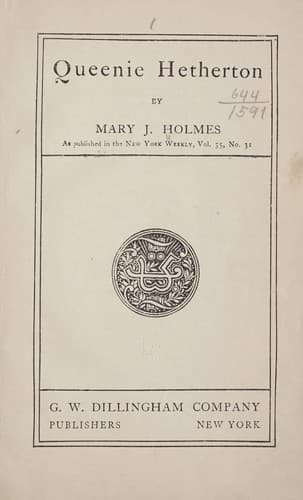
American fiction -- 19th century; Dime novels; Man-woman relationships -- Fiction; Upper class -- Fiction
“Let him sleep; it will do him good and keep back the dreadful vomit,”
Christine had said, and not for worlds would Queenie disobey her. She
held a human life in her keeping, and with her finger on her lip to
Pierre, who crouched almost at her feet, she seated herself in an
arm-chair just where she could see the outline of the figure upon the
bed, and there for hours she sat and watched, and listened to the
irregular breathing, while every kind of wild fancy danced through her
brain, and her limbs began at last to feel prickly and numb, and a sense
of cold and faintness to steal over her.
The air in the room was hot and oppressive though the windows were
opened wide. Outside, the rain was falling heavily, and the sky as black
as ink; there was no sound to break the awful stillness, except the
occasional tread of some physician or nurse on duty, or the crash of
distant wheels, whose meaning Queenie understood full well, shuddering
as she thought of the rapid burials which the peril made necessary, and
remembering what she had read of the great plague in London, where the
death-cart rolled nightly through the street, while the dreadful cry was
heard:
“Bring out your dead; bring out your dead.”
The words kept repeating themselves over and over in Queenie’s mind
until her brain became confused; the present faded away into the far-off
past, and she was one of those weary watchers in London, listening to
the cry:
“Bring out your dead.”
And she was bringing hers—was carrying the young man whose long limbs
dragged upon the floor, and whose head drooped upon her shoulder, while
his dead face, not yet cold, touched hers with a caressing motion which
brought with it a thought of poor Phil, lying beneath the Indian waters.
It was a horrid nightmare, and Queenie struggled with it a moment, and
then awoke with a cry of Phil upon her lips—a cry so loud that the
sleeper upon the bed started a little, and moaned, and said something
indistinctly, and moved uneasily, then settled again into slumber, and
all was quiet as ever.
But Queenie stood erect upon her feet, rigid as a piece of marble, and
almost as white, while her eyes, which seemed to Pierre to shoot out
gleams of fire, were turned wildly toward the form lying so motionless
across the room, with the white, shapely hand still outside the
counterpane, and the light brown wavy hair upon the pillow. He had
spoken—had called a name, which the excited girl had recognized as her
own. She could _not_ be mistaken. In answer to her cry for _Phil_ the
fever patient had aroused a little and responded:
“Queenie.”
She was sure of it. He might not have meant _her_, it is true. There
were other Queenies in the world, no doubt, but he had called her
name—this man, who in her dream she was carrying to the death-cart, and
who might perhaps, go there when the morning dawned.
Public-domain text, read in full here on John Shaqi.
Reviews
Reviews
No reviews yet
Be the first to share your thoughts on this work.
Elsewhere in the archive
Join the Discussion
Join the discussion
Sign in to leave a comment or review.
Sign InorCreate an account