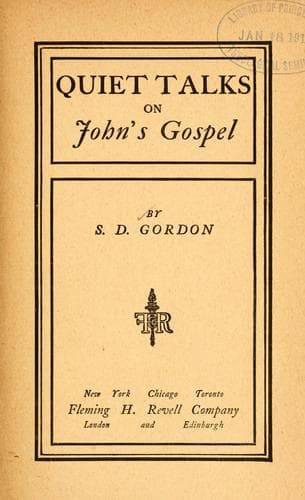
Quiet Talks on John's GospelGordon, S. D. (Samuel Dickey)
Religion
Quiet Talks on John's Gospel
Gordon, S. D. (Samuel Dickey)
Bible. John -- Criticism, interpretation, etc.
He was the person of God wearing a human coat and human shoes,
hand-pegged, walking in freely amongst us that we might get our tangled
up ideas about God and ourselves and about life untangled, straightened
out. He was God Himself wrapped up in human form coming close that we
might get acquainted with Him all over again.
This is part of the meaning of the little five-lettered word in his own
tongue that John chooses and uses, at the first here, as a new name for
Him who was commonly called Jesus. It was because of our ears that he
used the new word. If he had said "Jesus" at once, they would have said
"Oh! yes, we know about Him." And at once their ears would have gone
shut to the thing that John is saying.
For they didn't know. And we don't. We know _words_. The thing, the real
thing, we know so little. So John uses a new word at the first, and so
floods in new light. And then we come to see whom he is talking about.
It's a bit of the diplomacy of God so as to get in through dulled ears
and truth-hardened minds down in to the heart.
Nature always seems eager to meet a defect. It seems to hurry eagerly
forward to overcome defects and difficulties. The blind man has more
acute hearing and a more delicate sense of feel. The deaf man's eyes
grow quicker to watch faces and movements and so learn what his ears
fail to tell him. The lame man leans more on other muscles, and they
answer with greater strength to meet the defect of the weaker muscles.
The bat has shunned the light so long through so many bat-generations
that it has become blind, but it has remarkable ears, and nature has
grown for it an abnormal sense of touch, and a peculiar sensitiveness
even where there is no contact, so that it avoids obstacles in flying
with a skill that seems uncanny, incredulous.
I remember in Cincinnati one night, sitting on the platform of a public
meeting by the side of a widely known Christian worker and speaker who
was blind. As various men spoke he quietly made brief comments to me,--"
_He_ doesn't strike fire." And then, "_He_ doesn't touch them." And
then, "Ah! _he's_ got them; that's it; now they're burning." And it was
exactly so as he said. I sat fascinated as I watched the crowd and heard
his comments. The sense of discerning what was going on in another way
than by sight had been grown in him by the very necessity of his
blindness. Defect in one sense was overcome by nature, by increase in
another sense.
Public-domain text, read in full here on John Shaqi.
Reviews
Reviews
No reviews yet
Be the first to share your thoughts on this work.
Join the Discussion
Join the discussion
Sign in to leave a comment or review.
Sign InorCreate an account