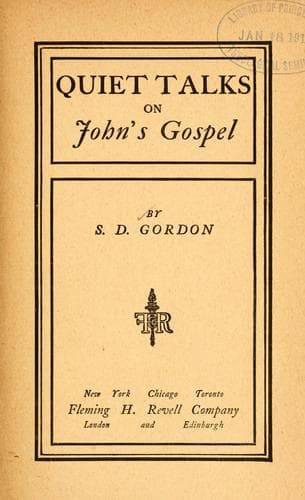
Quiet Talks on John's GospelGordon, S. D. (Samuel Dickey)
Religion
Quiet Talks on John's Gospel
Gordon, S. D. (Samuel Dickey)
Bible. John -- Criticism, interpretation, etc.
You can't _comprehend_ Jesus. That is just the simple plain fact. You
may have a fine mind. It may be well schooled and trained. You may have
dug into all the books on the subject, English and German and the few
French. You may have spent a lifetime at it. But at the end there is
immensely more of Jesus that you don't understand than the part that you
do understand. You've touched the smaller part only, just the edges. You
cannot take Jesus in with your mind simply. The one is too big and the
other too limited for that particular process.
But, listen with your heart, you can _apprehend_ Him. You can _take
hold_ of Him. There isn't one of us here, however poorly equipped
mentally and in training, and too busy with life's common duties to get
much time for reading, not one of us, who may not reach out your hand,
the hand of your heart, the hand of your life, the hand of your simple
childlike trust--if you're great enough in simplicity to be childlike,
to be natural, not one of us, but may reach out the hand and _take in
all there is of Jesus_.
And the striking thing to mark is this, that we don't really begin to
comprehend until we apprehend. Only as we take Him into heart and life
_can_ we really understand. It's as if the heat in the heart made by His
presence there loosens up the grey juices of your brain, and it begins
to work freely and clearly.
Of course, this is a commonplace in the educational world. It is well
understood there that no student does his best work, no matter what
that work may be, in science or philosophy or in mathematics or in
laboratorial research, his mind cannot do its best, or be at its best,
until his heart has been kindled by some noble passion. The key to the
life is in the heart, that is the emotions and purposes tied together.
The approach to the mind is through the heart. The fire of pure emotion
and of noble purpose burning together, works out _through_ the mind
_into_ the life. This is nature's order.
But what John is saying here, put into as simple language as he would
use, is this: "_the darkness wouldn't let the light in, and couldn't
shut it out, and couldn't dull the brightness of its shining_." It
tried. It tried first at Bethlehem. The first spilling of blood came
there. There was the shedding of blood at both ends of Jesus' career,
and innocent blood each time. It tried at the Nazareth precipice, and in
the spirit-racking wilderness. It tried by stones, then in Gethsemane,
then at Calvary.
And there it seemed to have succeeded. At last the light was shut in and
down; the door was shut and barred and bolted. And I suppose there was
great glee in the headquarters of darkness. But the Third Morning came.
And the bars of darkness were broken, as a woman breaks the
sewing-cotton at the end of the seam. The Light could not be held down
by darkness. It broke out more brightly than ever. The darkness couldn't
shut the light out. And it can't.
Public-domain text, read in full here on John Shaqi.
Reviews
Reviews
No reviews yet
Be the first to share your thoughts on this work.
Join the Discussion
Join the discussion
Sign in to leave a comment or review.
Sign InorCreate an account