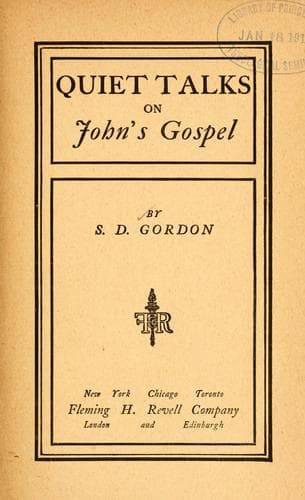
Quiet Talks on John's GospelGordon, S. D. (Samuel Dickey)
Religion
Quiet Talks on John's Gospel
Gordon, S. D. (Samuel Dickey)
Bible. John -- Criticism, interpretation, etc.
The bother is we don't always get the verbs, the action words, of that
sentence straight. John was a man _sent_ from God. And he _came_. All
men are sent But they don't all come, some _go_; go their own way. There
was a man sent from God whose name was Jonah. But he didn't come. He
went. He was sent to Nineveh on the extreme east. He went towards
Tarshish on the extreme west; just the opposite direction. Every man is
headed either for Nineveh or Tarshish, God's way or his own. Which way
are you headed?
Some of us go to Tarshish _religiously_. We go our own way, and sing
hymns and pray, to make it seem right and keep from hearing the inner
voice. We hold meetings at the boat-wharf, while waiting for the
Tarshish ship to lift anchor. We have services in the steerage and
second-class and distribute tracts and New Testaments; but all the time
we're headed for Tarshish; our way, not God's. It won't do simply to do
good. We must do God's will. Find that and fit into it.
The meetings and tracts are only good but they ought to be on the train
to Nineveh, and in Nineveh where God's sent you. Are you berthed on the
boat for Tarshish? or have you a seat engaged on the train for Nineveh?
going your own way? or God's? John was _sent_ and he _came_. You and I
are sent. Are we coming or going? coming God's way? or, going our own?
Living Martyrs.
This true-hearted burning man of the deserts _came for a witness_. Here
we strike one of John's great words. You remember the three things that
_witness_ means? that you know something; that you tell what you know;
and that you tell it most with your life. And telling it _with your
life_ means, not only by the way you live, but, too, even though the
telling of it _may cost you your life_. It came to mean all of that with
this witness.
It came to mean that with a new fullness of meaning, a peculiar
significance, to _the great Witness_, of whom John told. This was the
very throbbing heart of the wooing errand. This explains the tenderness
and tenacity of the Lover in His wooing in the midst of intensest
opposition, and in spite of it.
The opposition brought about the terrific grouping of circumstances
which the great Lover-witness used as the tremendous climax of both
wooing and witnessing. No one doubts the reality of Jesus' witness to
the Father's love before men. And no one, who has had any touch at all
with Him, doubts the tremendous pull upon one's heart of such a wooing
appeal as that Calvary climax of witnessing made, and makes.
And this, mark it keenly, is still the plan. "The-same-came-for-witness"
is meant to be true of each follower of the Christ. This is to be the
dominant underchording of all our lives. This is to be the never-absent
motive gripping us, and our possessions and our plans. The rest is
incidental in a true life.
Public-domain text, read in full here on John Shaqi.
Reviews
Reviews
No reviews yet
Be the first to share your thoughts on this work.
Join the Discussion
Join the discussion
Sign in to leave a comment or review.
Sign InorCreate an account