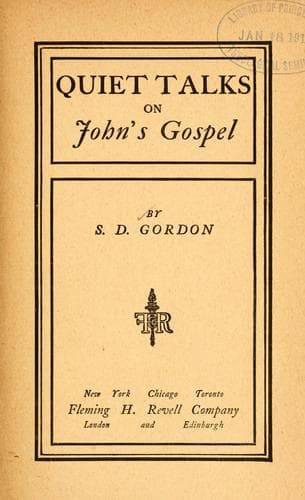
Quiet Talks on John's GospelGordon, S. D. (Samuel Dickey)
Religion
Quiet Talks on John's Gospel
Gordon, S. D. (Samuel Dickey)
Bible. John -- Criticism, interpretation, etc.
He remembered his dear old mother, of course. He sent her money, and
fabrics for dresses, and wrote her. But for a long time, in the busy
absorption of his life, he had not been to see her. And the dear old
mother in the little cottage in the country lived in the sweet
consciousness that her son was a great physician up in the great London.
He was her chief topic of conversation. When the neighbours were in she
would always talk of her son, her Laddie, she called him.
"He's so good to me, my Laddie is. He sends me money. I put it in the
bank. He sends me cloth for dresses; it's quite too good for a plain
body like me. And he writes me letters, such good letters, wonderful
letters. But he's so busy up there, that he hasn't been to see me for a
long time now. You know he's a great doctor now, and he has great skill,
and there are so many needing him. And he's no time at all, even for
himself, I expect. But"--she would always finish her talk as they sat
over the tea by saying, half to herself, really more to herself than to
the little group, with a half-repressed longing sigh, "but, I wish, I
just _wish_ I could _see_ my _Laddie_."
Then some changes took place on the estate. And the cottage where she
had lived so long must be given up. And the dear old woman had to make
new plans. And she cudgeled her old head, and thought, and at last she
said to herself, "I know what I'll do. I'll go-up to London, and I'll
live with Laddie. He'll be so glad to have me." And bright-coloured
visions flitted through her mind, as she sat over her tea by the open
grate. But she wouldn't send him word; no, no, she would surprise him,
and add to his pleasure.
And the dear old soul, in her fine simplicity, did not think into what
this would mean, nor of the difference that had grown up with the years,
in manner of life, between her son and herself. He was a cultured
gentleman, with his well-appointed city home, and the circle of friends
that had grown up about him. And she was a simple uncultured country
woman with a broad provincial twist on her tongue. But she was
blissfully unconscious of this. She would go and live with her Laddie.
It would be so delightful for them both.
And so she went. It was her first train journey, and quite a time of it
she had finding the house. But at last she stands looking up at the
house. "Ugh! does my Laddie live here! in this great mansion?" But there
was the name on the door-plate. There was no mistaking that. And so she
rang the bell. "Is the doctor in?" She could hardly get the word
"doctor" out. She had never called him that before, just Laddie. But now
she must say it. "Is the doctor in?" And the word almost stuck in her
throat as she thought to herself, "This poor man opening the door
doesn't know that the 'doctor' really belongs to _me_."
But in a hard voice the servant said that it was past the hours. She
couldn't see the doctor.
"Ah! bat," she said, quite taken by surprise at being held there, "I
_must_ see him."
Public-domain text, read in full here on John Shaqi.
Reviews
Reviews
No reviews yet
Be the first to share your thoughts on this work.
Join the Discussion
Join the discussion
Sign in to leave a comment or review.
Sign InorCreate an account