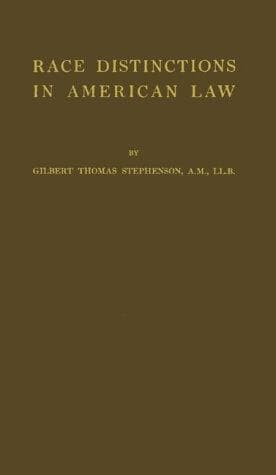
Race Distinctions in American LawStephenson, Gilbert Thomas
History
Race Distinctions in American Law
Stephenson, Gilbert Thomas
African Americans -- Politics and government; Law -- United States -- History; United States -- Race relations
Footnote 764:
Herron’s Sup. to Sayles’s Civil Stat., 1906, p. 165.
Footnote 765:
Const., 1895, art. IV.
Footnote 766:
Statutes, 1906, p. 104.
Footnote 767:
Const., 1889, art. VI.
Footnote 768:
Const., 1872, art. IV, sec. 1.
Footnote 769:
Const., 1848, art. III.
Footnote 770:
Const., 1889, art. VI.
Footnote 771:
Code, 1907, part V, sec. 199.
Footnote 772:
Revised Stat., 1901, sec. 2282.
Footnote 773:
Revised Laws, 1901, secs. 18, 60, and 63.
Footnote 774:
Organic Act, 1850, sec. 6; Compiled Laws, 1897, secs. 1647, 1672, and
1677–78.
Footnote 775:
_The Outlook_, vol. 91, p. 78.
CHAPTER XII
RACE DISTINCTIONS _VERSUS_ RACE DISCRIMINATIONS
Heretofore, the writer has let the legislatures and courts speak for
themselves, withholding personal opinions and refraining from making
deductions from the facts revealed. Now, however, that the various race
distinctions have been reviewed at some length, it may be worth while to
consider what conclusions the facts warrant and what practical lessons
they suggest.
RACE DISTINCTIONS NOT CONFINED TO ONE SECTION
Race distinctions are not confined to any one section of the country.
This conclusion is the most patent of all. There is scarcely a State or
Territory in the Union where legislative or judicial records do not
reveal the actual existence of at least some race distinctions. Of the
twenty-six States and Territories that prohibit intermarriage, more than
half, extending from Delaware to Oregon, are outside the South. Negroes
have, on account of their race, been excluded, usually contrary to the
local laws, from hotels in Massachusetts, Pennsylvania, Indiana, New
York, Wisconsin, Michigan, Ohio, and Iowa; from barber-shops, in
Nebraska and Connecticut; from bootblack stands, in New York; from
billiard-rooms, in Massachusetts; from saloons, in Minnesota and Ohio;
from soda fountains, in Illinois; from theatres, in Illinois and New
York; from skating rinks in New York and Iowa; and the bodies of Negroes
have been refused burial with those of white persons in Pennsylvania. It
is not meant here that Negroes are always excluded from such places in
these States, but that instances of such exclusions are found in the
laws. Most of the States have at one time or another made distinctions
between the races in schools. California and other States of the Far
West are demanding separate schools for Japanese. Ohio, Indiana,
Illinois, and Iowa, besides other States of the Middle West, clash from
time to time with their school boards for attempting to separate the
races in schools. Delaware is diligent in providing separate schools for
white persons and Negroes. In Massachusetts, until 1857, the school
board of Boston provided a separate school for Negroes in that city. As
to public conveyances, the term “Jim Crow,” applied to a car set apart
for Negroes, was first used in Massachusetts, and it was in Pennsylvania
Public-domain text, read in full here on John Shaqi.
Reviews
Reviews
No reviews yet
Be the first to share your thoughts on this work.
Elsewhere in the archive
Join the Discussion
Join the discussion
Sign in to leave a comment or review.
Sign InorCreate an account