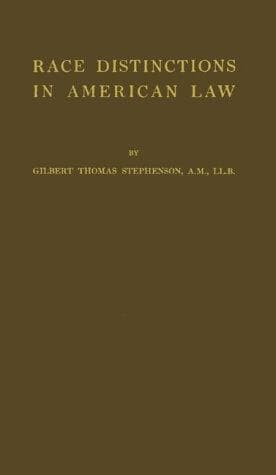
Race Distinctions in American LawStephenson, Gilbert Thomas
History
Race Distinctions in American Law
Stephenson, Gilbert Thomas
African Americans -- Politics and government; Law -- United States -- History; United States -- Race relations
The people of the different sections and races, instead of inquiring
into the truth or falsity of such a conclusion, have been agitating the
theoretical right and wrong of race distinctions. Meanwhile, indications
are that legalized race distinctions have been unfairly enforced. For
instance, statutes require that equal accommodations be given Negro
passengers in public conveyances; yet, while people have been debating
the constitutionality and justification of the “Jim Crow” laws, railroad
companies have been compelling Negroes to occupy uncomfortable and
unsanitary coaches and waiting-rooms, and this though Negroes paid the
same fare as white passengers. Furthermore, while they have been arguing
the constitutionality of the suffrage laws of the South, white
registrars have been putting unfair tests to Negro applicants for
registration, and by so doing have made the laws a tool by which to work
injustice to the Negro. While, finally, they have been strenuously
discussing the school laws, Negro children have been suffering from, not
only inadequate but, in many cases, improper training by ignorant Negro
teachers.
In suggesting the benefits that would accrue to the weaker race from
legalized race distinctions, it is assumed that such distinctions would
apply only in communities in which two races live side by side in
something like equal numbers. The white people of the South should
recognize the inexpediency of requiring separate schools, separate
railroad and street cars, separate hotels, and separate accommodations
in general for the colored races in most places outside the South where
they constitute, in many instances, not more than one-tenth of the total
population. The white people in the places last mentioned should
recognize that it would be equally unwise to crowd together white and
colored races in schools, public conveyances, hotels, theatres, and
other public places in the South. Colored people everywhere should
realize that a race distinction is not necessarily a badge of racial
inferiority, but may be simply a natural result of racial
differentiation. Race distinctions may, therefore, have a very
appropriate place in communities where, as has been said before, two
races are about equal in numbers, at least where there are enough of the
subordinate race to arouse in the dominant a feeling of race
consciousness.
Public-domain text, read in full here on John Shaqi.
Reviews
Reviews
No reviews yet
Be the first to share your thoughts on this work.
Elsewhere in the archive
Join the Discussion
Join the discussion
Sign in to leave a comment or review.
Sign InorCreate an account