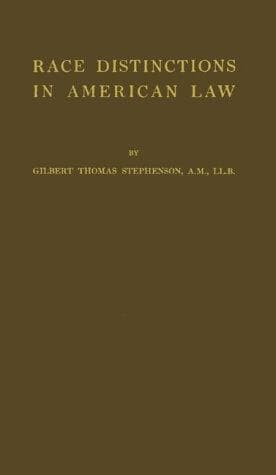
Race Distinctions in American LawStephenson, Gilbert Thomas
History
Race Distinctions in American Law
Stephenson, Gilbert Thomas
African Americans -- Politics and government; Law -- United States -- History; United States -- Race relations
Let one imagine the existence of a Federal statute—waiving the question
of its constitutionality—prohibiting States from legalizing race
distinctions, so that all public places of amusement, accommodation, and
instruction would be, so far as the law could make them, open to all
persons, regardless of race. Such a measure, far from effecting its
purpose, would doubtless be the beginning of extensive race
discriminations. Once abolish separate hotel accommodations and the
white race, wherever it is in the majority, would monopolize every
hotel, leaving other races either to walk the streets or to find
accommodations in private houses. Were separate street car
accommodations forbidden in cities where there is a fairly large
percentage of Negroes, if any passenger were forced to stand or be
crowded off the car altogether, it would be the Negro. Were separate
schools not permitted, Negro children might possibly be excluded from
schools altogether in defiance of the law; but even if admitted, their
interests, if different from those of the more numerous race, would have
to be sacrificed. A further review of race distinctions now legally
recognized would only more fully substantiate the conclusion that, with
race feeling as it is, if such distinctions were not recognized and
enforced, the stronger race would naturally appropriate the best for
itself and leave the weaker race to fare as it could.
On the other hand, let one imagine that the same laws recognizing race
distinctions as now exist in the South obtained in all communities where
two races are nearly equal in numbers. Suppose, for instance, that
separate hotels were permitted in all cities which receive an
appreciable number of Negro travelers. Respectable Negroes might then
secure comfortable entertainment in hotels provided for their race and
thus escape the inconvenience and humiliation of being denied admission
to hotels maintained exclusively for white persons. If separate schools
were provided, Negro children would be free to pursue, unhampered by
requirements prescribed for the more developed race and unembittered by
continuous manifestations of race prejudice, a curriculum especially
adapted to their own needs. Wherever separate railroad and street car
accommodations were provided, a Negro might enter the car or compartment
reserved for his race and go his way in peace, unmolested by the
thoughtless or vicious of the other race. The result, therefore, of the
honest enforcement of race distinctions would be to the advantage of the
weaker race.
OBLITERATION OF RACE DISCRIMINATIONS
Public-domain text, read in full here on John Shaqi.
Reviews
Reviews
No reviews yet
Be the first to share your thoughts on this work.
Elsewhere in the archive
Join the Discussion
Join the discussion
Sign in to leave a comment or review.
Sign InorCreate an account