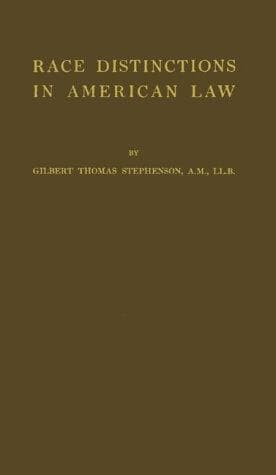
Race Distinctions in American LawStephenson, Gilbert Thomas
History
Race Distinctions in American Law
Stephenson, Gilbert Thomas
African Americans -- Politics and government; Law -- United States -- History; United States -- Race relations
The master had the right to command the servant to aid him in the
defence of his own person, family, premises, or property. He did not
have to furnish medicine or medical assistance to the servant unless he
especially agreed to do so.
The master might inform a prospective employer of the character of a
Negro who had been in his service, and this was a privileged
communication unless falsely and maliciously made. The servant could not
make a new contract without producing the discharge of his former master
or of the district judge or magistrate.
If the master was convicted of a felony or if he managed or controlled
his servants so as to make them a nuisance to the neighborhood, any
white freeholder might complain to the district judge and have the
contract annulled, and the master could not employ any colored servant
within two years.
A servant had the right to leave his master’s service for: (1) an
insufficient supply of food; (2) an unauthorized battery upon his person
or upon a member of his family, not committed in the defence of the
person, family, guest, or agent of the master; (3) invasion by the
master of the conjugal rights of the servant; (4) or failure by the
master to pay wages when due. In any one of the above cases, the servant
might collect his wages due him at the time of his departure.
If the master died, the contract—contrary to the usual rule of law—was
not terminated without the assent of the servant. His wages up to one
year took preference over other debts of the master. If the servant was
wrongfully discharged, he could collect wages for the whole period of
the contract. Upon the servant’s discharge or the expiration of his term
of service, the master must furnish him a certificate of discharge, and
upon his request, a certificate of character. If the servant forged or
altered this certificate—as by falsely claiming that he had been in a
certain previous service—he was guilty of a misdemeanor, punishable by a
fine of not over one hundred dollars. All disputes as to alleged
wrongful discharges or departures were to be heard by the district
judge, who could compel the master to take back the servant or forfeit a
penalty of a fine of twenty dollars; or compel the servant to return to
his master under pain of corporal punishment or fine.
A servant was not liable for contracts made by the express authority of
his master. Nor was he liable civilly or criminally for any act done by
the command of his master in defence of his master’s person, family,
guest, servant, premises, or property.
Negroes employed as house servants had, at “all hours of the day and
night, and on all days of the week,” to answer promptly all calls and
execute all lawful orders and commands of the master’s family. They had
to be especially civil and polite to their master, his family, and
guests, for which they in turn should “receive gentle and kind
treatment.”
Public-domain text, read in full here on John Shaqi.
Reviews
Reviews
No reviews yet
Be the first to share your thoughts on this work.
Join the Discussion
Join the discussion
Sign in to leave a comment or review.
Sign InorCreate an account