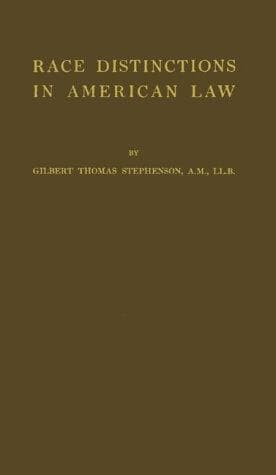
Race Distinctions in American LawStephenson, Gilbert Thomas
History
Race Distinctions in American Law
Stephenson, Gilbert Thomas
African Americans -- Politics and government; Law -- United States -- History; United States -- Race relations
Persons of different races who attempt to intermarry in violation of the
laws subject themselves everywhere to severe penalties. In Alabama, the
law says they shall be imprisoned in the penitentiary for not less than
two, nor more than seven years. In Colorado, they are guilty of a
misdemeanor and punishable by a fine of from fifty dollars to five
hundred dollars, or imprisonment for not less than three months nor more
than two years, or both. In Delaware, they are guilty of a misdemeanor
and may be fined one hundred dollars. Florida says they shall be
imprisoned in the State penitentiary not exceeding ten years or fined
not exceeding one thousand dollars. In Indiana, if they knowingly
violate the law—that is, if the white person knows the other is a Negro
or of mixed blood—they are fined not less than one hundred dollars nor
more than one thousand dollars, or imprisoned in the State prison not
less than one nor more than ten years. Maryland declares that they are
guilty of an infamous crime, punishable by imprisonment in the
penitentiary not less than eighteen months nor more than ten years.
Mississippi makes the punishment a fine of five hundred dollars,
imprisonment not exceeding ten years, or both. The law of Missouri
declares that one who knowingly intermarries in violation of the statute
shall be punished by imprisonment in the penitentiary two years or by a
fine not less than one hundred dollars, or by imprisonment in the county
jail not less than three months, or by both such fine and imprisonment,
and adds that the jury shall determine the amount of Negro blood by
appearance. Nevada enacts that the parties are guilty of a misdemeanor
and shall be imprisoned in the State prison not less than one nor more
than two years. North Carolina brands an attempted intermarriage as an
infamous crime to be punished by imprisonment in the county jail or
State prison not less than four months nor more than ten years, and the
parties may also be fined at the discretion of the court. Oklahoma makes
it a felony and provides that the parties shall be punished by a fine of
not less than one hundred dollars nor more than five hundred dollars or
imprisonment not less than thirty days nor more than one year, or both.
Oregon simply makes it an offence punishable by imprisonment in the
penitentiary or county jail between three months and one year. South
Carolina[192] declares attempted intermarriage is a misdemeanor
punishable by a fine of not less than five hundred dollars or
imprisonment in the penitentiary from one to five years. Texas, by a law
of 1858, still in force in 1879, prescribed a punishment for the white
person who attempted to marry a Negro but no punishment for the Negro. A
Federal court[193] held that the difference of punishment was in
violation of the Fourteenth Amendment, but that the law against
intermarriage was constitutional. Virginia provides that the parties
shall be confined in the penitentiary not less than two nor more than
Public-domain text, read in full here on John Shaqi.
Reviews
Reviews
No reviews yet
Be the first to share your thoughts on this work.
Join the Discussion
Join the discussion
Sign in to leave a comment or review.
Sign InorCreate an account