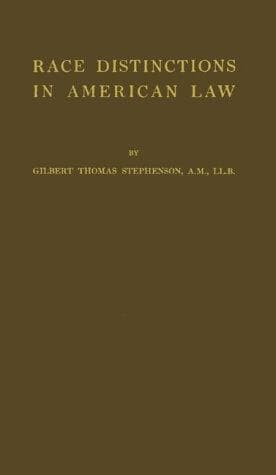
Race Distinctions in American LawStephenson, Gilbert Thomas
History
Race Distinctions in American Law
Stephenson, Gilbert Thomas
African Americans -- Politics and government; Law -- United States -- History; United States -- Race relations
It is important, at the outset, to distinguish clearly between race
_distinctions_ and race _discriminations_; more so, because these
words are often used synonymously, especially when the Negro is
discussed. A distinction between the Caucasian and the Negro, when
recognized and enforced by the law, has been interpreted as a
discrimination against the latter. Negroes have recognized that they
are the weaker of the two races numerically, except in the Black Belt
of the South, and intellectually the less developed. Knowing that the
various race distinctions have emanated almost entirely from white
constitution-makers, legislators, and judges, they regard these
distinctions as expressions of the aversion on the part of the
Caucasian to association with the Negro. Naturally, therefore, they
have resented race distinctions upon the belief and, in many
instances, upon the experience that they are equivalent to race
discriminations.
In fact, there is an essential difference between race distinctions and
race discriminations. North Carolina, for example, has a law that white
and Negro children shall not attend the same schools, but that separate
schools shall be maintained. If the terms for all the public schools in
the State are equal in length, if the teaching force is equal in numbers
and ability, if the school buildings are equal in convenience,
accommodations, and appointments, a race distinction exists but not a
discrimination. Identity of accommodation is not essential to avoid the
charge of discrimination. If there are in a particular school district
twice as many white children as there are Negro children, the school
building for the former should be twice as large as that for the latter.
The course of study need not be the same. If scientific investigation
and experience show that in the education of the Negro child emphasis
should be placed on one course of study, and in the education of the
white child, on another; it is not a discrimination to emphasize
industrial training in the Negro school, if that is better suited to the
needs of the Negro pupil, and classics in the white school if the latter
course is more profitable to the white child. There is no discrimination
so long as there is equality of opportunity, and this equality may often
be attained only by a difference in methods.
Public-domain text, read in full here on John Shaqi.
Reviews
Reviews
No reviews yet
Be the first to share your thoughts on this work.
Join the Discussion
Join the discussion
Sign in to leave a comment or review.
Sign InorCreate an account